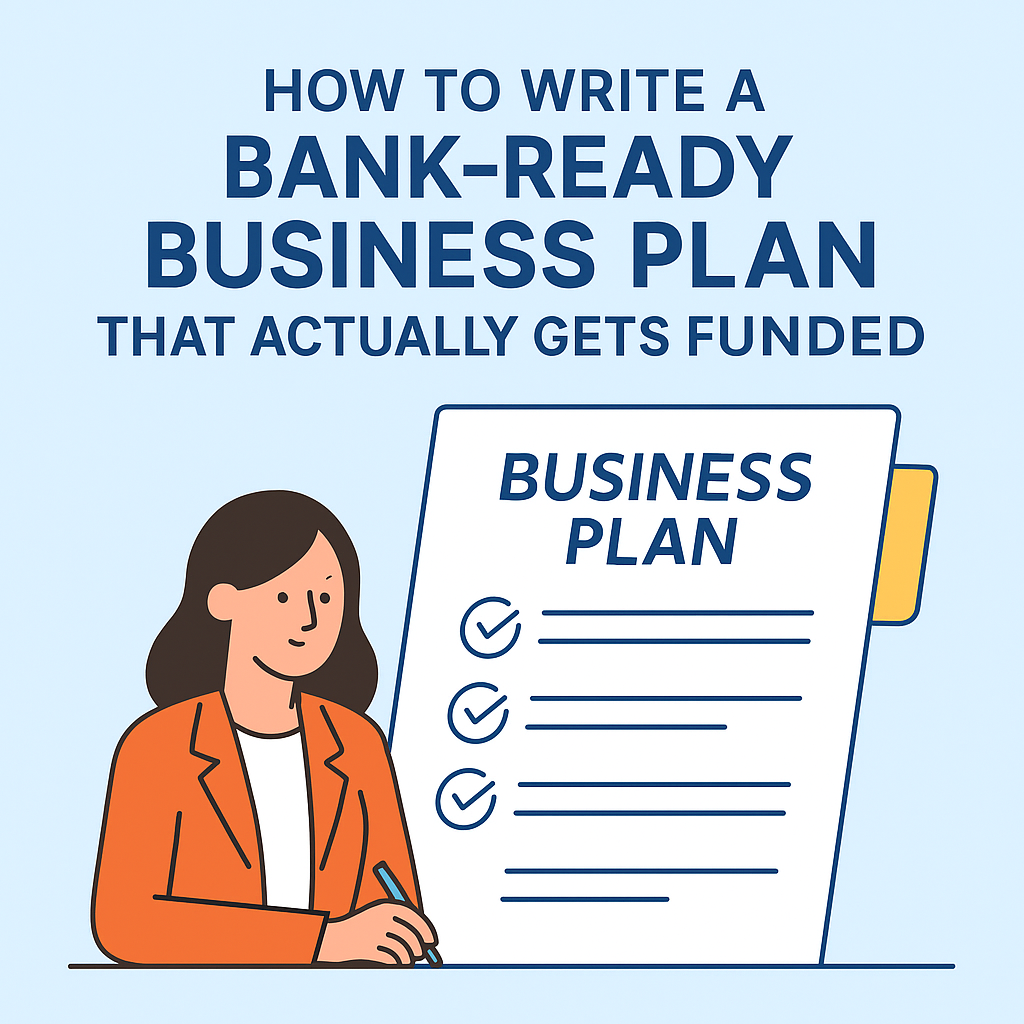
How to Write a Bank‑Ready Business Plan That Actually Gets Funded

Securing financing is one of the biggest hurdles small business owners face—and a strong business plan is often the deciding factor between approval and rejection. Banks don’t just want a vision; they want proof that your business is viable, profitable, and capable of repaying the loan.

Below is a practical, lender‑focused guide to crafting a business plan that gives you the best shot at getting funded.


1. Executive Summary (Your First Impression Matters)

Think of your executive summary as the “elevator pitch” for your entire plan. Lenders read this section first—and often decide right away whether the rest is worth their time.

A strong executive summary should:

  • Clearly state what your business does
  • Identify your target market
  • Explain why you’ll succeed
  • Highlight how much money you’re requesting and what it will be used for

Pro tip: Write this section last. It’s easier once you’ve completed the rest of the plan.


2. Company Description (Tell Your Business Story)

Lenders want context—who you are, what you do, and why your business exists.

Include:

  • Business history (if applicable)
  • Mission and core values
  • Legal structure
  • Location and service area
  • Your unique value proposition

3. Market Analysis (Show You Understand Your Industry)

Banks approve businesses that understand their customers and competitors. A thorough market analysis builds confidence.

Cover:

  • Industry size & growth trends
  • Your ideal customer profile
  • Competitor strengths/weaknesses
  • Your price position in the market
  • Market demand and barriers to entry

Back up every claim with real data whenever possible.


4. Business Model & Operations Plan (Prove You Can Execute)

This section outlines how your business operates day‑to‑day.

Include:

  • How your product or service is delivered
  • Suppliers and partners
  • Staffing plan
  • Operational workflow
  • Technology and systems

Banks want to see structure and scalability.


5. Marketing & Sales Strategy (Show How You’ll Get Customers)

Explain:

  • Your marketing channels
  • Lead generation strategy
  • Sales process
  • Customer retention plan
  • Pricing strategy

This demonstrates how you’ll generate revenue—and keep it coming.


6. Management Team (Highlight Expertise & Credibility)

A strong team reduces lender risk.

Include:

  • Owner and key team member bios
  • Relevant experience
  • Organizational chart
  • Advisory support (if applicable)

7. Financial Projections (The Section Banks Focus On Most)

Provide:

  • 2–3 years of projected income
  • Cash‑flow forecasts
  • Balance sheet estimates
  • Break‑even analysis
  • A clear repayment plan

Keep projections realistic—not overly optimistic.


8. Funding Request (Be Clear and Specific)

Spell out exactly:

  • How much money you’re requesting
  • What each dollar will be used for
  • How the funding moves the business forward

Lenders appreciate clarity and specificity.


9. Supporting Documents (Reinforce Credibility)

Add items such as:

  • Bank statements
  • Tax returns
  • Permits
  • Contracts or leases
  • Resumes
  • Product images or mockups

Your goal is to eliminate uncertainty before it arises.


Final Thoughts

A bank‑ready business plan doesn’t just help you secure financing—it becomes a roadmap for growth. Done right, it shows lenders that you have clarity, discipline, and a real strategy for success.

If your business needs help, contact us at
👉 https://commresinc.com

Small Business Financing in 2026: What Commercial Clients Need to Know Before Securing Capital

For many businesses, securing capital isn’t just about growth — it’s about survival, stability, and staying competitive in a marketplace transformed by technology and rising costs. In 2026, small business financing has become more flexible, more data‑driven, and more specialized, offering companies a wider variety of tools to fund their operations, equipment needs, and expansion plans. However, this new landscape also demands that business owners make smarter, more strategic funding choices.

This guide breaks down the most important financing trends and tools shaping the market today — and what they mean for Commercial Resources’ clients who rely on smart, accessible capital solutions.


1. Today’s Lending Environment Is Faster, Smarter, and Data‑Driven

Traditional lending models have shifted dramatically. Instead of relying mainly on credit scores and historical tax returns, many lenders now use real‑time financial data pulled directly from accounting and commerce platforms to assess risk. Systems such as QuickBooks, Stripe, Amazon, and Shopify now feed lenders live cash‑flow intelligence.

At the same time, interest rates remain higher than pre‑pandemic levels, and lenders — both traditional banks and fintech companies — expect businesses to provide clear financials and repayment plans before approving applications.

What this means for Commercial Resources clients:
Your real‑time financial health matters more than ever. Clean books, accurate statements, and steady revenue data help you secure better rates and faster approvals.

2. Smaller, Purpose‑Driven Loans Are Becoming the Norm

One of the most notable trends moving into 2026 is the shift toward smaller, targeted financing products. Instead of large, broad‑use loans, businesses now secure capital for highly specific purposes — such as equipment upgrades, inventory cycles, marketing pushes, or short‑term working capital needs.

Lenders favor these smaller, project‑based loans because they carry less risk and have clearer return pathways.

What this means for Commercial Resources clients:
A well‑defined purpose for your funding request — such as equipment replacement or facility upgrades — dramatically increases approval odds.

3. Revenue‑Based Financing Is Expanding, Especially for Online Sellers

Revenue‑based financing (RBF) continues to gain traction, especially among eCommerce and digital‑first businesses. With RBF, repayment is tied to a percentage of future revenue — meaning payments flex as sales fluctuate.

Platforms like Onramp Funds provide fast access to capital (sometimes within 24 hours) by integrating directly with online sales platforms.

What this means for Commercial Resources clients:
If your business has cyclical or seasonal revenue, RBF may offer the flexibility you need without the pressure of fixed monthly payments.


4. Traditional Loans Still Matter — but Preparation Is Essential

Despite new alternatives, conventional business loans remain a cornerstone of commercial financing. They often offer lower long‑term costs, predictable amortization, and access to higher dollar amounts. However, lenders now expect:

  • clean, accurate financial statements
  • clear cash‑flow projections
  • a defined use of funds
  • proof of repayment capacity

Loan approvals are increasingly based on real‑time operational health rather than long‑term credit history alone.

What this means for Commercial Resources clients:
Well‑prepared documentation and clearly defined needs help secure better, more stable financing terms.


5. Grants and Tax Incentives Offer Often‑Overlooked Opportunities

Every year, small businesses miss out on valuable grants and tax credits simply because they aren’t aware they exist.

For example:

Notable Grants (Public + Private)

Grants from American Express, QuickBooks, DoorDash, and other national programs support a range of industries

Powerful Federal Tax Credits

  • Section 179 Deduction: write off up to $1.22 million on equipment and software purchases in 2026
  • R&D Tax Credit: offsets 6–14% of qualified R&D expenditures, even for non‑tech businesses [esplawyers.com]

What this means for Commercial Resources clients:
If you’re acquiring equipment or improving products/processes, leveraging tax incentives can dramatically reduce out‑of‑pocket spending.


6. Relief Programs Still Provide Critical Support

Many businesses still qualify for federal, state, and private relief programs — including grants, credits, subsidized loans, and sector‑specific assistance. Many owners incorrectly assume they won’t qualify, leaving thousands of dollars unused.

What this means for Commercial Resources clients:
It’s worth reviewing relief programs annually — many are industry‑specific and underutilized.


7. Strategic Financing Helps You Grow Without Draining Cash

A common mistake business owners make is using their operating cash to fund expansions — weakening payroll stability, inventory budgets, and emergency reserves.

Instead, experienced businesses separate:

  • operating capital (day‑to‑day expenses)
  • expansion financing (growth investments)

Strategic financing enables growth while protecting liquidity.

What this means for Commercial Resources clients:
Financing should fuel expansion — not jeopardize your operational cash flow.


8. Preparing for Financing in 2026

To get the best rates and widest range of options, businesses should be prepared with:

  • updated financial statements
  • clean, reliable bookkeeping
  • consistent revenue records
  • a clear explanation of how funds will be used
  • organized digital financial data for lenders who integrate with accounting platforms

With fintech lenders increasingly using real‑time data to evaluate your business, clean financial systems have become essential.


Final Thoughts

Small business financing in 2026 is more dynamic, more flexible, and more technologically advanced than ever before. Whether you need capital for equipment, expansion, staffing, or cash‑flow stabilization, today’s market offers more options than at any point in history.

But choosing the right financing tool requires clarity, preparation, and strategy.

Commercial Resources is here to help your business navigate this evolving landscape, secure the capital you need, and grow without compromising your operational stability.

Challenges Business Owners Face When Needing Financing

Securing financing is one of the most critical steps in building, growing, or sustaining a business. Yet, for many business owners, accessing the right funding at the right time feels overwhelmingly complex. Whether you’re seeking capital for expansion, equipment, payroll, or cash‑flow stabilization, the challenges are often universal. Understanding these hurdles can help business owners better prepare — and choose partners like Commercial Resources who simplify the process.


1. Strict Lending Requirements

Traditional lenders often require strong credit histories, substantial collateral, and detailed financial records. Even profitable businesses may struggle to meet every requirement, particularly newer companies or those in industries considered “higher risk.”

Common lender expectations include:

  • High personal and business credit scores
  • Multi-year financial statements
  • Significant collateral
  • A lengthy operating history

Businesses that fall short are often denied, even if they show strong potential.


2. Cash Flow Limitations

Cash flow is one of the biggest indicators lenders examine. Seasonal businesses, companies with slow-paying customers, or businesses experiencing rapid growth often face cash flow gaps — creating red flags for lenders.

Even temporary dips can impact:

  • Loan approval
  • Loan size
  • Interest rates offered

This creates a catch‑22: businesses need financing to stabilize cash flow, but they need strong cash flow to get financing.


3. Limited Awareness of Funding Options

Many business owners only consider traditional bank loans, not realizing there are alternative, flexible financing solutions that may better fit their needs.

Examples include:

  • Equipment financing
  • Working capital advances
  • Invoice factoring
  • Merchant cash advances
  • Asset‑based lending
  • Lines of credit designed for businesses with fluctuating revenue

Without understanding these options, owners may delay financing, accept unfavorable terms, or assume they won’t qualify at all.


4. Time Constraints and Slow Approvals

Running a business leaves little time for lengthy paperwork and repeated lender requests. Traditional financing can take weeks or even months to process.

This is especially challenging when funding is needed for:

  • Immediate operational costs
  • Sudden equipment failure
  • Seasonal inventory demands
  • Growth opportunities with short windows

When time is money, slow approvals can cost more than the financing itself.


5. Difficulty Preparing Documentation

Lenders often require:

  • Tax returns
  • Profit & loss statements
  • Bank statements
  • Debt schedules
  • Accounts receivable aging reports
  • Business plans

Many business owners simply don’t have these documents readily organized, especially those without dedicated financial staff. Preparing them can cause stressful delays.


6. High Interest Rates or Unfavorable Terms

Even when financing is approved, terms may not be ideal. Some owners face:

  • Higher‑than‑expected rates
  • Short repayment periods
  • Large upfront fees
  • Personal guarantees
  • Daily or weekly repayment schedules

These terms may solve a short-term need but strain long-term operations if not carefully evaluated.


7. Impact of Economic Conditions

Economic uncertainty — rising interest rates, supply chain issues, inflation, or sector-specific downturns — can tighten lending environments. Even well-established businesses may face reduced borrowing capacity simply due to market shifts outside their control.


How Commercial Resources Helps

Commercial Resources understands these challenges and works to eliminate friction in the financing process. By connecting businesses with flexible funding solutions tailored to their industry, revenue model, and timing needs, Commercial Resources ensures owners receive realistic options without unnecessary barriers.

Whether you need fast working capital, equipment financing, or a customized lending solution, the team is dedicated to simplifying every step.

The Power of Small Business: How Local Companies Drive Big Impact

Small businesses are the heartbeat of the American economy. While large corporations often dominate the headlines, it’s the locally owned shops, service providers, contractors, and niche specialists who shape communities, create jobs, and keep local economies moving. For organizations like Commercial Resources Inc., which support businesses through facility services, repairs, and commercial maintenance, understanding the needs and challenges of small business owners is essential.

Below are some valuable insights small business owners can use to stay competitive, strengthen operations, and grow with confidence.


1. Small Businesses Create Real Community Value

Small businesses provide more than just products or services—they offer connection, familiarity, and accessibility. Customers often choose local providers because they value trust and personalized service. For service‑based businesses—like contractors, maintenance teams, and commercial trade professionals—that personal reputation is everything.

Why this matters:

  • Local businesses reinvest money in their own community.
  • They build long‑term relationships with customers and other local companies.
  • Being small makes it easier to pivot quickly, adapt, and innovate.

2. Operational Efficiency Is a Superpower

In a small business, every dollar matters. Improving operational efficiency doesn’t require enterprise‑level tools—it starts with tightening processes and partnering with reliable vendors.

Ways businesses can improve efficiency:

  • Streamline scheduling and maintenance with digital tools.
  • Outsource specialized work instead of taking on extra overhead.
  • Build relationships with trusted commercial service providers for faster response times.

Companies like Commercial Resources Inc. help small businesses stay focused on what they do best by handling complex facility or property needs in the background.


3. Preventive Maintenance Saves Time and Money

Many small businesses operate reactively—waiting for something to go wrong before fixing it. But preventive maintenance can significantly reduce downtime and emergency repair costs.

Key advantages of staying proactive:

  • Fewer unexpected disruptions
  • Longer lifespan for equipment and facilities
  • Better budgeting with predictable maintenance costs

For example, a small retail shop that schedules routine electrical, plumbing, and HVAC checks will spend far less than one who waits for breakdowns.


4. Technology Levels the Playing Field

Small businesses don’t need huge budgets to use technology to their advantage. Even simple digital tools can help owners run more efficiently.

Examples include:

  • Online booking systems
  • Automated invoicing
  • Inventory alerts
  • Customer communication platforms

These tools allow small businesses to compete with larger organizations by offering convenient, reliable, modern service.


5. Strong Vendor Partnerships Can Fuel Growth

Many small businesses grow faster when they collaborate with trusted service partners instead of trying to manage everything internally.

The right partner can:

  • Reduce costs
  • Improve service quality
  • Provide expertise that small teams may not have in-house
  • Support expansion by handling facilities and operational needs

Whether you’re running a restaurant, small office, retail space, or service company, a dependable commercial services partner keeps operations running smoothly so you can focus on your customers.