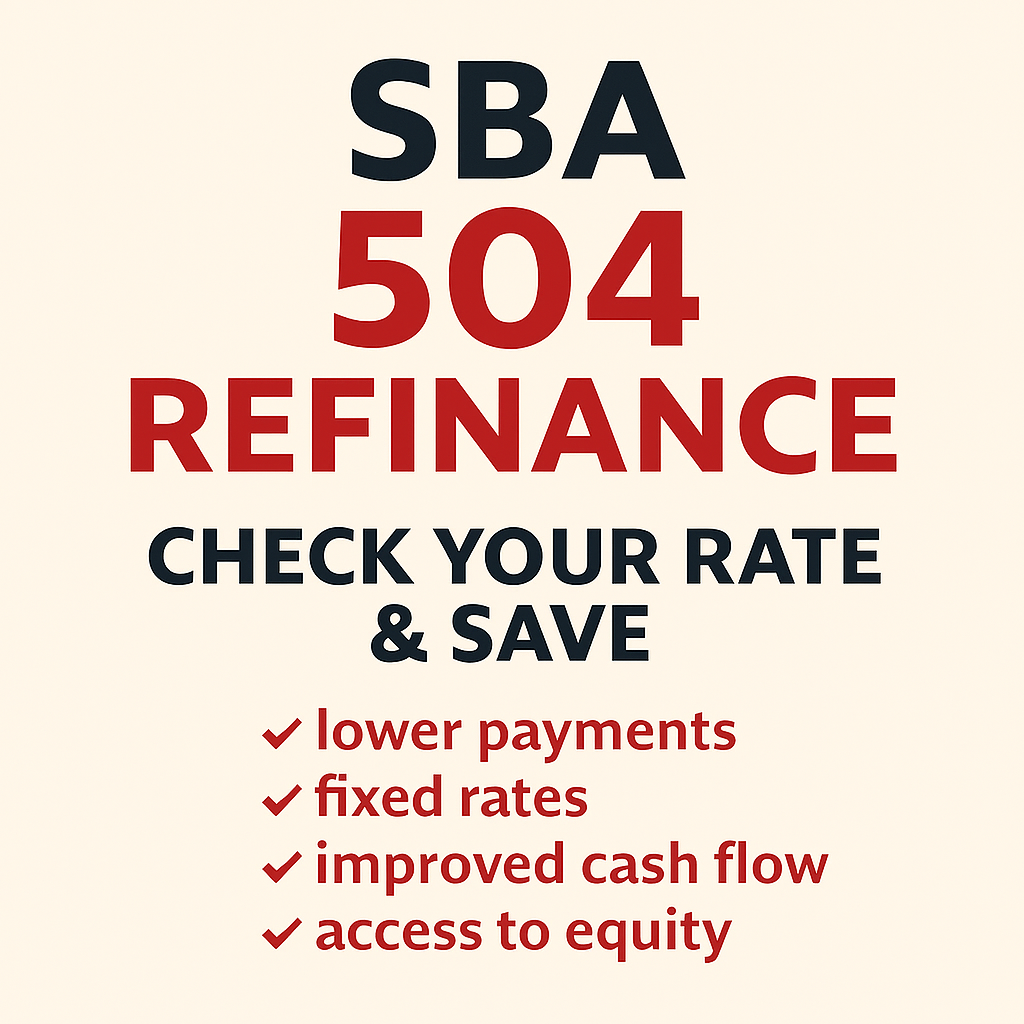
SBA 504 Refinance: Unlock Better Rates & Strengthen Your Business

If your business is carrying high-interest debt tied to real estate or equipment, an SBA 504 refinance could be one of the smartest financial moves you make.

With today’s evolving interest rate environment, now is the perfect time to check your rate and explore how refinancing can improve your cash flow, stability, and long-term growth.

What Is an SBA 504 Refinance?

The SBA 504 Loan Program was designed to help small businesses secure long-term, fixed-rate financing for major assets like commercial real estate and equipment.

Through refinancing, the SBA 504 program allows you to:

  • Replace existing commercial debt
  • Lock in lower, fixed interest rates
  • Access equity for business needs

This is a powerful option for businesses currently dealing with variable rates or higher-cost traditional loans.

Key Benefits of an SBA 504 Refinance

✅ 1. Lower Monthly Payments

Refinancing into a longer-term, fixed-rate structure often reduces your monthly payment, freeing up capital for operations, hiring, or expansion.

✅ 2. Fixed Interest Rates = Predictability

Unlike fluctuating rates, SBA 504 loans offer stable, long-term fixed rates, helping you plan your finances with confidence.

✅ 3. Improved Cash Flow

Lower payments plus stable rates = healthier cash flow, which is critical for:

  • Covering operating expenses
  • Investing in growth opportunities
  • Weathering economic uncertainty

✅ 4. Access to Equity

If your property has appreciated, refinancing may allow you to pull out usable equity to reinvest into your business.

✅ 5. Consolidate Business Debt

You may be able to combine multiple loans into one, simplifying your finances and reducing overall interest costs.

✅ 6. Strengthen Your Balance Sheet

Refinancing into better terms can improve your financial profile—making your business more attractive to lenders and investors.

Who Qualifies?

An SBA 504 refinance is ideal for businesses that:

  • Own and occupy commercial real estate
  • Have existing debt tied to that property
  • Are looking to lower rates or improve cash flow
  • Have been operating for at least 2 years (in most cases)

Even if you’re unsure, it’s worth taking a closer look—many businesses qualify sooner than they expect.

Why Now Is the Time to Check Your Rate

Interest rates shift constantly, and many businesses are still carrying loans secured during less favorable conditions.

That means you could be:

  • Paying more than necessary
  • Missing out on long-term savings
  • Limiting your growth potential

A simple rate check could reveal significant savings opportunities.

Real Impact: What Refinancing Can Do

Businesses that refinance using SBA 504 loans often see:

  • Lower operating stress
  • More available working capital
  • Better long-term planning ability
  • Increased profitability over time

It’s not just about saving money—it’s about positioning your business for success.

Take the Next Step: Check Your Rate

Refinancing doesn’t have to be complicated. The first step is simple:

👉 Check your current rate and explore your options

By comparing your existing loan with SBA 504 refinancing, you can quickly determine if there’s an opportunity to:

  • Save money
  • Improve cash flow
  • Strengthen your business

Final Thoughts

An SBA 504 refinance is more than a financial adjustment—it’s a strategic move that can give your business the stability and flexibility it needs to grow.

If you haven’t reviewed your loan recently, now is the time.

✅ Lower your rate
✅ Improve your cash flow
✅ Invest back into your business

🚀 Ready to see what you qualify for?

Check your rate today and take control of your financial future.

The 5 C’s of Credit Explained for Small Business Owners

When applying for any type of business financing—whether it’s an SBA loan, equipment loan, line of credit, or alternative funding—lenders rely on a foundational framework known as the 5 C’s of Credit. This system helps lenders evaluate your risk level and determine whether your business is a strong candidate for funding.

Understanding these five factors can significantly increase your chances of approval and help you prepare stronger, more compelling loan applications.


1. Character: Your Business Reputation & Reliability

Character is how lenders assess your trustworthiness. They want to know whether you consistently meet your financial obligations and operate your business responsibly.

Lenders typically review:

  • Personal and business credit history
  • Payment history with vendors or suppliers
  • Length of time in business
  • Public records (liens, judgments, bankruptcies)
  • Professional background of ownership

How to improve this C:

  • Pay bills early or on time
  • Resolve any outstanding negative marks
  • Build positive vendor credit (Net‑30 accounts, etc.)
  • Maintain clean and complete business records

2. Capacity: Your Ability to Repay the Loan

Capacity evaluates your business’s cash flow and profitability—basically, whether your business can afford the payments.

Lenders look at:

  • Revenue trends
  • Profit margins
  • Debt‑to‑income (DTI) or debt‑service‑coverage ratio (DSCR)
  • Existing financial obligations
  • Consistency of cash flow

How to improve this C:

  • Increase recurring revenue
  • Reduce unnecessary expenses
  • Separate personal and business finances
  • Maintain up‑to‑date financial statements

3. Capital: Your Investment in the Business

Lenders want to see that you have “skin in the game.” Capital refers to how much you’ve invested into your business and your financial strength as an owner.

This includes:

  • Personal funds invested
  • Business assets
  • Retained earnings
  • Savings or reserves
  • Tangible net worth

Why it matters: Businesses with more capital at stake are viewed as lower‑risk because owners are more likely to protect their investments.


4. Collateral: Assets That Secure the Loan

Collateral reduces the lender’s risk by giving them a claim on an asset if the loan goes unpaid.

Collateral can include:

  • Real estate
  • Equipment
  • Inventory
  • Vehicles
  • Accounts receivable
  • Business assets

Not all loans require collateral—SBA loans often allow alternative forms or partial collateral—but offering strong collateral can significantly increase approval odds.


5. Conditions: The Purpose of the Loan & Market Factors

Conditions refer to both:

✔ The specific conditions of your loan

– How much you’re requesting
– How you plan to use the funds
– Anticipated ROI

✔ External economic conditions

– Industry trends
– Local market stability
– Interest rate environment
– Regulatory changes

Lenders want to ensure your funding request is logical, strategic, and beneficial to your business’s long‑term success.


Why the 5 C’s Matter

Mastering the 5 C’s can dramatically improve your ability to:

  • Get approved for larger loan amounts
  • Qualify for lower interest rates
  • Access SBA or bank‑level financing
  • Build long‑term financial stability

Even if you don’t qualify today, focusing on these five areas can put your business in the strongest possible position for future funding opportunities.

Challenges Business Owners Face When Needing Financing

Securing financing is one of the most critical steps in building, growing, or sustaining a business. Yet, for many business owners, accessing the right funding at the right time feels overwhelmingly complex. Whether you’re seeking capital for expansion, equipment, payroll, or cash‑flow stabilization, the challenges are often universal. Understanding these hurdles can help business owners better prepare — and choose partners like Commercial Resources who simplify the process.


1. Strict Lending Requirements

Traditional lenders often require strong credit histories, substantial collateral, and detailed financial records. Even profitable businesses may struggle to meet every requirement, particularly newer companies or those in industries considered “higher risk.”

Common lender expectations include:

  • High personal and business credit scores
  • Multi-year financial statements
  • Significant collateral
  • A lengthy operating history

Businesses that fall short are often denied, even if they show strong potential.


2. Cash Flow Limitations

Cash flow is one of the biggest indicators lenders examine. Seasonal businesses, companies with slow-paying customers, or businesses experiencing rapid growth often face cash flow gaps — creating red flags for lenders.

Even temporary dips can impact:

  • Loan approval
  • Loan size
  • Interest rates offered

This creates a catch‑22: businesses need financing to stabilize cash flow, but they need strong cash flow to get financing.


3. Limited Awareness of Funding Options

Many business owners only consider traditional bank loans, not realizing there are alternative, flexible financing solutions that may better fit their needs.

Examples include:

  • Equipment financing
  • Working capital advances
  • Invoice factoring
  • Merchant cash advances
  • Asset‑based lending
  • Lines of credit designed for businesses with fluctuating revenue

Without understanding these options, owners may delay financing, accept unfavorable terms, or assume they won’t qualify at all.


4. Time Constraints and Slow Approvals

Running a business leaves little time for lengthy paperwork and repeated lender requests. Traditional financing can take weeks or even months to process.

This is especially challenging when funding is needed for:

  • Immediate operational costs
  • Sudden equipment failure
  • Seasonal inventory demands
  • Growth opportunities with short windows

When time is money, slow approvals can cost more than the financing itself.


5. Difficulty Preparing Documentation

Lenders often require:

  • Tax returns
  • Profit & loss statements
  • Bank statements
  • Debt schedules
  • Accounts receivable aging reports
  • Business plans

Many business owners simply don’t have these documents readily organized, especially those without dedicated financial staff. Preparing them can cause stressful delays.


6. High Interest Rates or Unfavorable Terms

Even when financing is approved, terms may not be ideal. Some owners face:

  • Higher‑than‑expected rates
  • Short repayment periods
  • Large upfront fees
  • Personal guarantees
  • Daily or weekly repayment schedules

These terms may solve a short-term need but strain long-term operations if not carefully evaluated.


7. Impact of Economic Conditions

Economic uncertainty — rising interest rates, supply chain issues, inflation, or sector-specific downturns — can tighten lending environments. Even well-established businesses may face reduced borrowing capacity simply due to market shifts outside their control.


How Commercial Resources Helps

Commercial Resources understands these challenges and works to eliminate friction in the financing process. By connecting businesses with flexible funding solutions tailored to their industry, revenue model, and timing needs, Commercial Resources ensures owners receive realistic options without unnecessary barriers.

Whether you need fast working capital, equipment financing, or a customized lending solution, the team is dedicated to simplifying every step.