SBA 504 Loan Program: Refinance vs. the New Expanded Opportunities

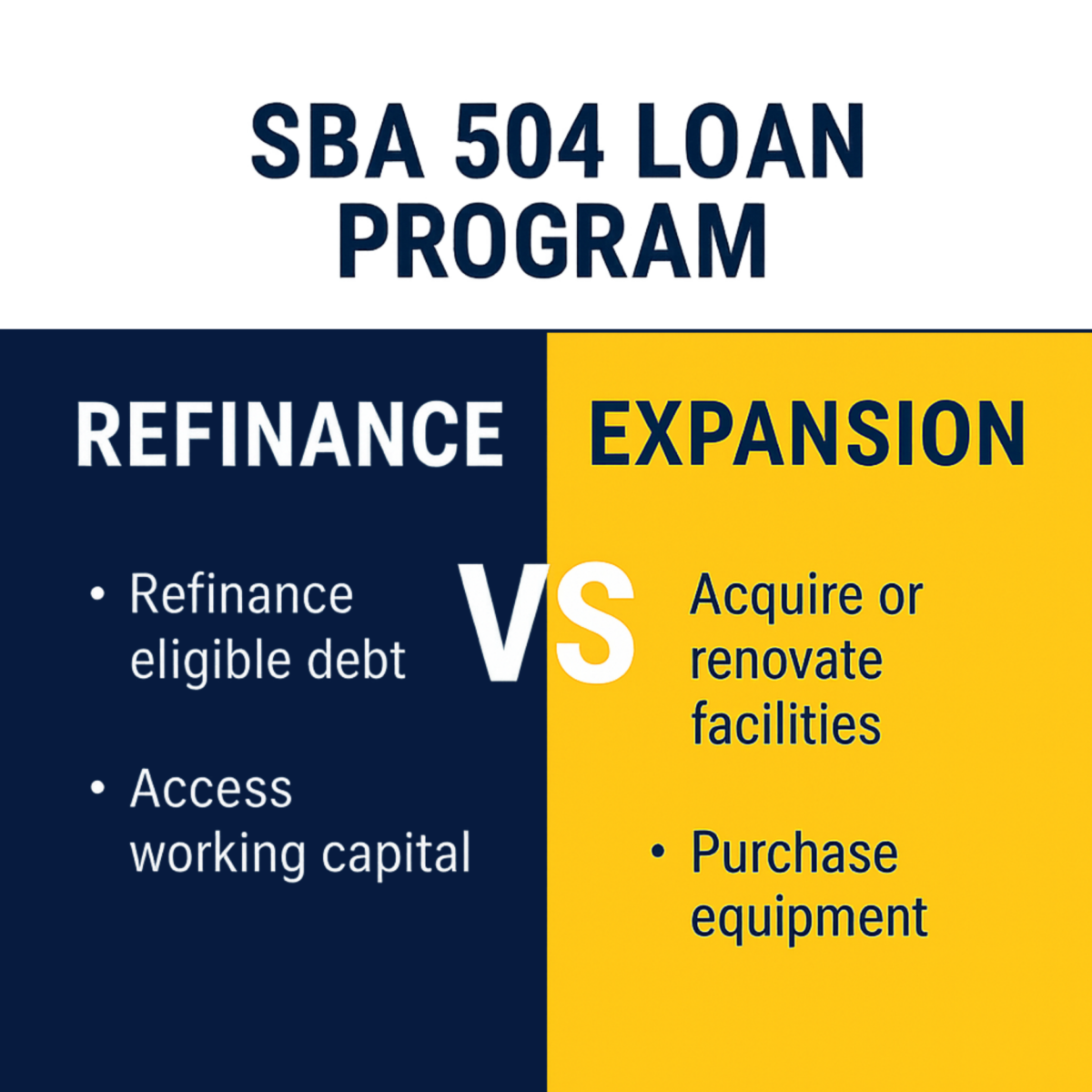
The SBA 504 loan program has expanded significantly, offering greater flexibility than traditional refinancing. Learn the key differences and how businesses can unlock more capital.

The SBA 504 loan program has expanded significantly, offering greater flexibility than traditional refinancing. Learn the key differences and how businesses can unlock more capital.
Many business owners secured SBA 7(a) loans at a time when interest rates were historically low. Today, those same loans—often structured with adjustable rates—are becoming increasingly expensive as rates fluctuate upward. For companies that value predictable cash flow and long‑term stability, this creates an important question:
Is there a better financing structure for the long haul?
For owner‑occupied commercial real estate, the answer is often yes—and it comes in the form of an SBA 504 refinance.
SBA 7(a) loans are flexible and widely used, but many are tied to the Prime Rate and adjust periodically. As interest rates rise, borrowers can experience:
For businesses that rely on steady financial planning, these variables can introduce unnecessary risk.
The SBA 504 refinance program is designed specifically for long‑term assets like owner‑occupied commercial real estate. Its defining feature is long‑term, fixed‑rate financing, which contrasts sharply with the variable nature of most 7(a) loans.
A typical 504 refinance structure includes:
This structure allows businesses to replace uncertainty with stability.
SBA 504 debentures offer fixed rates for 20 or 25 years, helping business owners insulate themselves from future rate increases. This predictability supports more confident long‑term planning.
By refinancing into a longer, fixed amortization, many businesses can reduce monthly debt service, freeing up cash for working capital, staffing, or reinvestment.
Because the SBA 504 program typically requires no additional cash beyond standard equity levels, borrowers can preserve liquidity rather than tying up funds in refinancing costs.
For businesses that occupy at least 51% of their building, the SBA 504 refinance aligns financing terms with the reality of owning and operating commercial property—long‑term, stable, and growth‑oriented.
An SBA 504 refinance may be a strong fit if:
Even if your existing loan is relatively new, it may still be worth evaluating your options in today’s rate environment.
At Commercial Resources, we view financing as more than a transaction—it’s a tool that should support your business strategy. Refinancing a variable‑rate SBA 7(a) loan into a fixed‑rate SBA 504 structure can help reduce risk, enhance predictability, and strengthen your financial foundation over time.
For business owners navigating today’s interest‑rate landscape, the right refinancing decision can make a meaningful difference for years to come.