How to Write a Bank‑Ready Business Plan That Actually Gets Funded

Securing financing is one of the biggest hurdles small business owners face—and a strong business plan is often the deciding factor between approval and rejection. Banks don’t just want a vision; they want proof that your business is viable, profitable, and capable of repaying the loan.

Below is a practical, lender‑focused guide to crafting a business plan that gives you the best shot at getting funded.


1. Executive Summary (Your First Impression Matters)

Think of your executive summary as the “elevator pitch” for your entire plan. Lenders read this section first—and often decide right away whether the rest is worth their time.

A strong executive summary should:

  • Clearly state what your business does
  • Identify your target market
  • Explain why you’ll succeed
  • Highlight how much money you’re requesting and what it will be used for

Pro tip: Write this section last. It’s easier once you’ve completed the rest of the plan.


2. Company Description (Tell Your Business Story)

Lenders want context—who you are, what you do, and why your business exists.

Include:

  • Business history (if applicable)
  • Mission and core values
  • Legal structure
  • Location and service area
  • Your unique value proposition

3. Market Analysis (Show You Understand Your Industry)

Banks approve businesses that understand their customers and competitors. A thorough market analysis builds confidence.

Cover:

  • Industry size & growth trends
  • Your ideal customer profile
  • Competitor strengths/weaknesses
  • Your price position in the market
  • Market demand and barriers to entry

Back up every claim with real data whenever possible.


4. Business Model & Operations Plan (Prove You Can Execute)

This section outlines how your business operates day‑to‑day.

Include:

  • How your product or service is delivered
  • Suppliers and partners
  • Staffing plan
  • Operational workflow
  • Technology and systems

Banks want to see structure and scalability.


5. Marketing & Sales Strategy (Show How You’ll Get Customers)

Explain:

  • Your marketing channels
  • Lead generation strategy
  • Sales process
  • Customer retention plan
  • Pricing strategy

This demonstrates how you’ll generate revenue—and keep it coming.


6. Management Team (Highlight Expertise & Credibility)

A strong team reduces lender risk.

Include:

  • Owner and key team member bios
  • Relevant experience
  • Organizational chart
  • Advisory support (if applicable)

7. Financial Projections (The Section Banks Focus On Most)

Provide:

  • 2–3 years of projected income
  • Cash‑flow forecasts
  • Balance sheet estimates
  • Break‑even analysis
  • A clear repayment plan

Keep projections realistic—not overly optimistic.


8. Funding Request (Be Clear and Specific)

Spell out exactly:

  • How much money you’re requesting
  • What each dollar will be used for
  • How the funding moves the business forward

Lenders appreciate clarity and specificity.


9. Supporting Documents (Reinforce Credibility)

Add items such as:

  • Bank statements
  • Tax returns
  • Permits
  • Contracts or leases
  • Resumes
  • Product images or mockups

Your goal is to eliminate uncertainty before it arises.


Final Thoughts

A bank‑ready business plan doesn’t just help you secure financing—it becomes a roadmap for growth. Done right, it shows lenders that you have clarity, discipline, and a real strategy for success.

If your business needs help, contact us at
👉 https://commresinc.com

The 5 C’s of Credit Explained for Small Business Owners

When applying for any type of business financing—whether it’s an SBA loan, equipment loan, line of credit, or alternative funding—lenders rely on a foundational framework known as the 5 C’s of Credit. This system helps lenders evaluate your risk level and determine whether your business is a strong candidate for funding.

Understanding these five factors can significantly increase your chances of approval and help you prepare stronger, more compelling loan applications.


1. Character: Your Business Reputation & Reliability

Character is how lenders assess your trustworthiness. They want to know whether you consistently meet your financial obligations and operate your business responsibly.

Lenders typically review:

  • Personal and business credit history
  • Payment history with vendors or suppliers
  • Length of time in business
  • Public records (liens, judgments, bankruptcies)
  • Professional background of ownership

How to improve this C:

  • Pay bills early or on time
  • Resolve any outstanding negative marks
  • Build positive vendor credit (Net‑30 accounts, etc.)
  • Maintain clean and complete business records

2. Capacity: Your Ability to Repay the Loan

Capacity evaluates your business’s cash flow and profitability—basically, whether your business can afford the payments.

Lenders look at:

  • Revenue trends
  • Profit margins
  • Debt‑to‑income (DTI) or debt‑service‑coverage ratio (DSCR)
  • Existing financial obligations
  • Consistency of cash flow

How to improve this C:

  • Increase recurring revenue
  • Reduce unnecessary expenses
  • Separate personal and business finances
  • Maintain up‑to‑date financial statements

3. Capital: Your Investment in the Business

Lenders want to see that you have “skin in the game.” Capital refers to how much you’ve invested into your business and your financial strength as an owner.

This includes:

  • Personal funds invested
  • Business assets
  • Retained earnings
  • Savings or reserves
  • Tangible net worth

Why it matters: Businesses with more capital at stake are viewed as lower‑risk because owners are more likely to protect their investments.


4. Collateral: Assets That Secure the Loan

Collateral reduces the lender’s risk by giving them a claim on an asset if the loan goes unpaid.

Collateral can include:

  • Real estate
  • Equipment
  • Inventory
  • Vehicles
  • Accounts receivable
  • Business assets

Not all loans require collateral—SBA loans often allow alternative forms or partial collateral—but offering strong collateral can significantly increase approval odds.


5. Conditions: The Purpose of the Loan & Market Factors

Conditions refer to both:

✔ The specific conditions of your loan

– How much you’re requesting
– How you plan to use the funds
– Anticipated ROI

✔ External economic conditions

– Industry trends
– Local market stability
– Interest rate environment
– Regulatory changes

Lenders want to ensure your funding request is logical, strategic, and beneficial to your business’s long‑term success.


Why the 5 C’s Matter

Mastering the 5 C’s can dramatically improve your ability to:

  • Get approved for larger loan amounts
  • Qualify for lower interest rates
  • Access SBA or bank‑level financing
  • Build long‑term financial stability

Even if you don’t qualify today, focusing on these five areas can put your business in the strongest possible position for future funding opportunities.

Small Business Financing in 2026: What Commercial Clients Need to Know Before Securing Capital

For many businesses, securing capital isn’t just about growth — it’s about survival, stability, and staying competitive in a marketplace transformed by technology and rising costs. In 2026, small business financing has become more flexible, more data‑driven, and more specialized, offering companies a wider variety of tools to fund their operations, equipment needs, and expansion plans. However, this new landscape also demands that business owners make smarter, more strategic funding choices.

This guide breaks down the most important financing trends and tools shaping the market today — and what they mean for Commercial Resources’ clients who rely on smart, accessible capital solutions.


1. Today’s Lending Environment Is Faster, Smarter, and Data‑Driven

Traditional lending models have shifted dramatically. Instead of relying mainly on credit scores and historical tax returns, many lenders now use real‑time financial data pulled directly from accounting and commerce platforms to assess risk. Systems such as QuickBooks, Stripe, Amazon, and Shopify now feed lenders live cash‑flow intelligence.

At the same time, interest rates remain higher than pre‑pandemic levels, and lenders — both traditional banks and fintech companies — expect businesses to provide clear financials and repayment plans before approving applications.

What this means for Commercial Resources clients:
Your real‑time financial health matters more than ever. Clean books, accurate statements, and steady revenue data help you secure better rates and faster approvals.

2. Smaller, Purpose‑Driven Loans Are Becoming the Norm

One of the most notable trends moving into 2026 is the shift toward smaller, targeted financing products. Instead of large, broad‑use loans, businesses now secure capital for highly specific purposes — such as equipment upgrades, inventory cycles, marketing pushes, or short‑term working capital needs.

Lenders favor these smaller, project‑based loans because they carry less risk and have clearer return pathways.

What this means for Commercial Resources clients:
A well‑defined purpose for your funding request — such as equipment replacement or facility upgrades — dramatically increases approval odds.

3. Revenue‑Based Financing Is Expanding, Especially for Online Sellers

Revenue‑based financing (RBF) continues to gain traction, especially among eCommerce and digital‑first businesses. With RBF, repayment is tied to a percentage of future revenue — meaning payments flex as sales fluctuate.

Platforms like Onramp Funds provide fast access to capital (sometimes within 24 hours) by integrating directly with online sales platforms.

What this means for Commercial Resources clients:
If your business has cyclical or seasonal revenue, RBF may offer the flexibility you need without the pressure of fixed monthly payments.


4. Traditional Loans Still Matter — but Preparation Is Essential

Despite new alternatives, conventional business loans remain a cornerstone of commercial financing. They often offer lower long‑term costs, predictable amortization, and access to higher dollar amounts. However, lenders now expect:

  • clean, accurate financial statements
  • clear cash‑flow projections
  • a defined use of funds
  • proof of repayment capacity

Loan approvals are increasingly based on real‑time operational health rather than long‑term credit history alone.

What this means for Commercial Resources clients:
Well‑prepared documentation and clearly defined needs help secure better, more stable financing terms.


5. Grants and Tax Incentives Offer Often‑Overlooked Opportunities

Every year, small businesses miss out on valuable grants and tax credits simply because they aren’t aware they exist.

For example:

Notable Grants (Public + Private)

Grants from American Express, QuickBooks, DoorDash, and other national programs support a range of industries

Powerful Federal Tax Credits

  • Section 179 Deduction: write off up to $1.22 million on equipment and software purchases in 2026
  • R&D Tax Credit: offsets 6–14% of qualified R&D expenditures, even for non‑tech businesses [esplawyers.com]

What this means for Commercial Resources clients:
If you’re acquiring equipment or improving products/processes, leveraging tax incentives can dramatically reduce out‑of‑pocket spending.


6. Relief Programs Still Provide Critical Support

Many businesses still qualify for federal, state, and private relief programs — including grants, credits, subsidized loans, and sector‑specific assistance. Many owners incorrectly assume they won’t qualify, leaving thousands of dollars unused.

What this means for Commercial Resources clients:
It’s worth reviewing relief programs annually — many are industry‑specific and underutilized.


7. Strategic Financing Helps You Grow Without Draining Cash

A common mistake business owners make is using their operating cash to fund expansions — weakening payroll stability, inventory budgets, and emergency reserves.

Instead, experienced businesses separate:

  • operating capital (day‑to‑day expenses)
  • expansion financing (growth investments)

Strategic financing enables growth while protecting liquidity.

What this means for Commercial Resources clients:
Financing should fuel expansion — not jeopardize your operational cash flow.


8. Preparing for Financing in 2026

To get the best rates and widest range of options, businesses should be prepared with:

  • updated financial statements
  • clean, reliable bookkeeping
  • consistent revenue records
  • a clear explanation of how funds will be used
  • organized digital financial data for lenders who integrate with accounting platforms

With fintech lenders increasingly using real‑time data to evaluate your business, clean financial systems have become essential.


Final Thoughts

Small business financing in 2026 is more dynamic, more flexible, and more technologically advanced than ever before. Whether you need capital for equipment, expansion, staffing, or cash‑flow stabilization, today’s market offers more options than at any point in history.

But choosing the right financing tool requires clarity, preparation, and strategy.

Commercial Resources is here to help your business navigate this evolving landscape, secure the capital you need, and grow without compromising your operational stability.

Understanding SBA Loans — A Smart Path to Small Business Growth

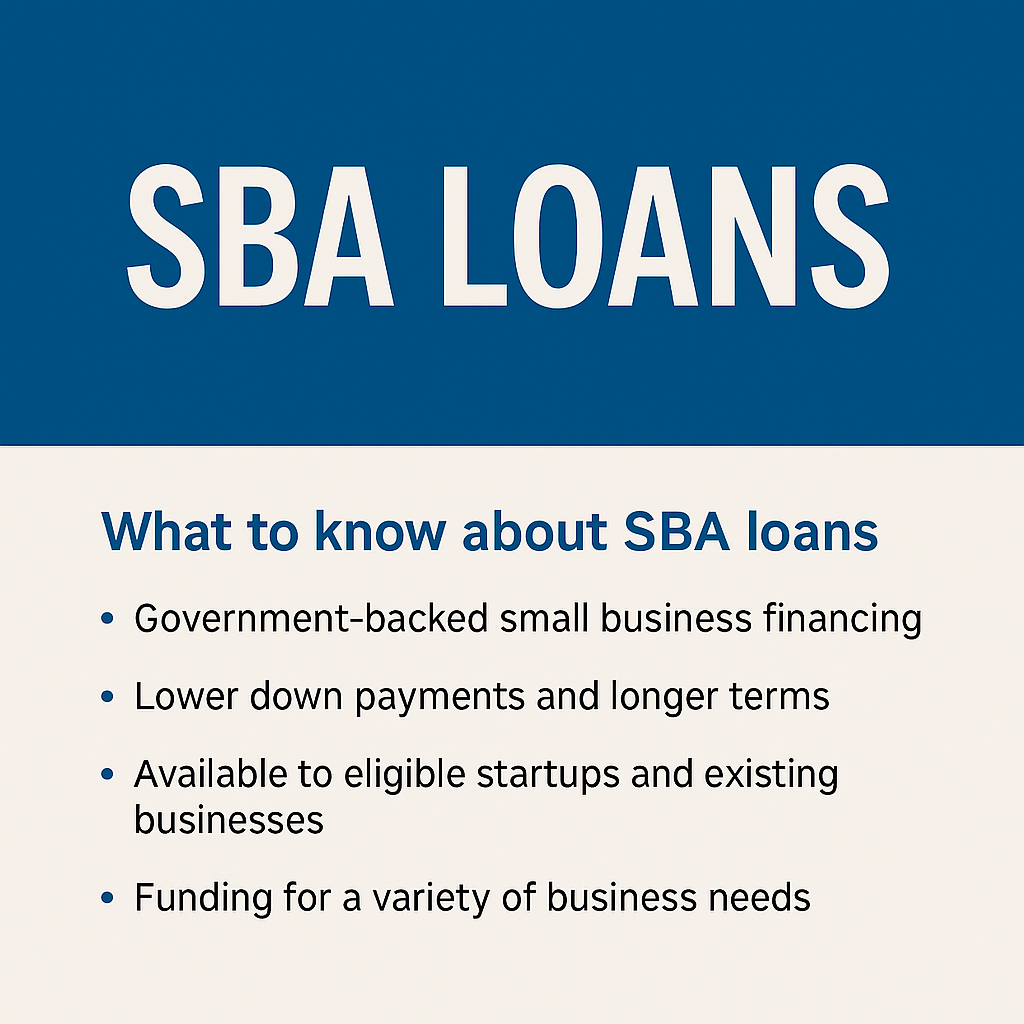
Small Business Administration (SBA) loans are one of the most effective and accessible financing tools available to entrepreneurs today. Whether you’re a startup looking to fund early operations or an established business wanting to expand, SBA loans provide the flexible, affordable support many traditional loans can’t match.

What Makes SBA Loans Unique?

Unlike conventional loans, SBA loans are partially guaranteed by the federal government. This reduces risk for lenders and makes it easier for small business owners to qualify. In many cases, SBA loans come with lower down payments, longer repayment terms, and competitive interest rates, making them a go‑to solution for businesses across industries.

💼 Types of SBA Loans

1. SBA 7(a) Loan

The most popular and versatile SBA loan.
Perfect for:

  • Working capital
  • Equipment purchases
  • Business acquisition
  • Expansion or renovation

2. SBA 504 Loan

Designed for large, long‑term investments such as:

  • Commercial real estate
  • Heavy machinery
  • Major infrastructure upgrades

3. SBA Microloans

Ideal for startups or very small businesses that need $50,000 or less.
Great for:

  • Initial inventory
  • Supplies
  • Small equipment

📋 Common Eligibility Requirements

To qualify for an SBA loan, lenders typically look for:

  • A solid business plan
  • Good personal and business credit
  • Proof of ability to repay
  • U.S.‑based business operating for profit

Because SBA loans are government‑backed, documentation requirements are more detailed — but the payoff is worth it for the lower risk and better terms.

🚀 How SBA Loans Support Business Growth

SBA loans help business owners:

  • Improve cash flow
  • Expand into new products or markets
  • Hire additional staff
  • Invest in long‑term assets
  • Build a stronger operational foundation

For many businesses, an SBA loan becomes the catalyst that drives long‑term success and stability.

📝 Final Thoughts

Securing financing can feel overwhelming, but SBA loans are intentionally designed to make capital more accessible for small businesses. With flexible repayment options and broad eligibility, they remain one of the most powerful tools for entrepreneurs ready to scale.

If you’re considering an SBA loan, now is a great time to evaluate your needs and prepare a strong application package. With the right preparation, SBA funding can provide the momentum your business needs to grow confidently and sustainably.

Understanding SBA 504 Loans: A Powerful Tool for Business Expansion

When your business is ready to grow, one of the most reliable ways to secure long‑term, affordable financing is through the SBA 504 Loan Program. Designed specifically to support business expansion and fixed‑asset investment, the 504 program helps small businesses build long‑term stability and increase their economic impact in the communities they serve.

What Is an SBA 504 Loan?

The SBA 504 loan is a government‑backed financing program created to help small businesses purchase major fixed assets. These are long‑term investments that directly support growth and productivity, such as:

  • Commercial real estate
  • Land or land improvements
  • Construction or building expansions
  • Heavy equipment and machinery

Unlike traditional loans, the 504 loan uses a three‑part structure:

  1. A bank or private lender covers roughly 50%.
  2. A Certified Development Company (CDC) provides up to 40%.
  3. The borrower contributes a relatively low 10% down payment (sometimes slightly more depending on the business type).

This structure significantly reduces upfront costs, making expansion more realistic for businesses that might otherwise struggle with large down payments.

Top Benefits of SBA 504 Loans

1. Long, Fixed Interest Rates

SBA 504 loans offer long‑term repayment periods, typically:

  • 10 years for equipment
  • 20–25 years for real estate

The interest rates are fixed, providing predictability and protection against market fluctuations.

2. Lower Down Payments

With down payments as low as 10%, businesses can conserve cash for operations, staffing, or working capital.

3. Supports Economic Development

Because SBA 504 loans are administered through CDCs, borrowers not only get financing—they also contribute to job creation and community growth.

4. No Balloon Payments

Many commercial loans come with balloon payments that can create financial stress. SBA 504 loans avoid that issue entirely.

Who Should Consider an SBA 504 Loan?

This program is ideal for businesses that are:

  • Planning to purchase or upgrade facilities
  • Investing in revenue‑generating equipment
  • Looking to expand without depleting cash reserves
  • Ready to own instead of lease space

Industries commonly benefiting from 504 financing include manufacturing, construction, healthcare, logistics, restaurants, and professional services.

Common Use Cases

  • Buying or building a new office, warehouse, or production facility
  • Expanding existing square footage
  • Investing in specialized equipment or machinery
  • Purchasing land for future development

Is an SBA 504 Loan Right for You?

If your business is stable, profitable, and poised for growth, the SBA 504 loan program can be a powerful catalyst. It allows you to make long‑term investments with confidence, predictable costs, and affordable terms.