
Cash Flow 101: What Every Small Business Owner Must Understand

Managing cash flow is one of the most essential skills for any small business owner. Even profitable businesses can struggle — or fail — if cash isn’t flowing in at the right time. Understanding how money moves in and out of your business gives you the power to plan, grow, and stay resilient during slow seasons or unexpected expenses.

What Is Cash Flow?

Cash flow is the movement of money into (inflows) and out of (outflows) your business.

  • Positive cash flow means more money is coming in than going out — ideal for stability and growth.
  • Negative cash flow means you have more expenses than revenue during a given period — a warning sign that requires quick action.

Even if revenue looks strong on paper, delayed payments, rising expenses, or seasonal demand can leave your bank account depleted.

Why Cash Flow Matters More Than Profit

You can be profitable without being cash‑flow positive.

For example:
You might land a big contract, but if the customer doesn’t pay for 60 days and you need to cover payroll tomorrow, you have a cash flow problem — not a profitability problem.

Cash flow directly affects your ability to:

  • Pay employees and vendors
  • Cover rent, utilities, and supplies
  • Invest in equipment or marketing
  • Take advantage of growth opportunities
  • Weather slow months without panic

Profit is long‑term.
Cash flow is day‑to‑day survival.

The Three Types of Cash Flow

Understanding where your cash comes from helps identify strengths and risks.

1. Operating Cash Flow

Everyday business activities: sales, services, vendor payments, wages, taxes.

2. Investing Cash Flow

Buying or selling long‑term assets: equipment, vehicles, property.

3. Financing Cash Flow

Loans, credit lines, owner investments, or dividend payouts.

Operating cash flow is the heartbeat of your business. If it’s consistently negative, something fundamental must change.

How to Improve Your Cash Flow

Here are practical steps you can implement immediately:

1. Speed Up Your Inflows

  • Invoice promptly and clearly
  • Offer early‑payment incentives
  • Accept multiple payment methods
  • Require deposits or partial payments for large projects

2. Slow Down Your Outflows

  • Negotiate better terms with vendors
  • Schedule payments closer to due dates
  • Reduce unnecessary recurring expenses

3. Monitor Your Cash Flow Weekly

Weekly reviews prevent surprises. Look for patterns:

  • Which months are slow?
  • Which expenses keep creeping up?
  • Are customers paying later than before?

4. Build a Cash Cushion

Aim for at least 1–3 months of operating expenses in reserve.
This buffer protects you from late payments or seasonal dips.

5. Use a Cash Flow Forecast

Project your cash position 30, 60, and 90 days ahead.
This helps you anticipate shortages before they hit.

Common Cash Flow Mistakes (and How to Avoid Them)

Counting sales before cash arrives

✔ Track real deposits — not promised payments.

Not budgeting for taxes

✔ Create a tax savings account and set aside a percentage of every sale.

Over‑ordering inventory

✔ Keep inventory levels aligned with real demand.

Ignoring rising expenses

✔ Audit subscriptions, service fees, and supply costs quarterly.

Not separating personal and business finances

✔ Use separate accounts so cash flow is easy to track and analyze.

Tools That Help You Track Cash Flow

  • Accounting software with dashboards (QuickBooks, Xero, Wave)
  • Cash flow forecasting apps
  • Business banking accounts with built‑in analytics
  • Simple spreadsheets for weekly check‑ins

The tool matters less than consistency.

Final Thoughts

Mastering cash flow isn’t just good financial practice — it’s a competitive advantage. Businesses that understand and monitor cash flow run more smoothly, make better decisions, and stay strong even during unpredictable times.

Whether you’re brand new or growing fast, cash flow is the foundation. When you manage it well, everything else becomes easier.

The Hidden Cost of Doing Everything Yourself: Why Small Businesses Need to Embrace Delegation in 2026

Running a small business often means wearing many hats—owner, marketer, accountant, customer service rep, salesperson, operations manager, and more. For many entrepreneurs, this “do-it-all” mindset feels like a badge of honor. But in 2026, as competition tightens and digital tools evolve, doing everything yourself isn’t just exhausting—it’s expensive.

Delegation is no longer a “nice to have.” It’s a strategic advantage. And for small business owners feeling stretched thin, it may be the missing piece holding the business back from its full potential.


The Hidden Cost of Doing Everything Yourself

Entrepreneurs often underestimate the true cost of handling every task alone. The hours spent updating a website, posting on social media, scheduling appointments, or managing finances come with a trade-off—time not spent on revenue‑generating activities.

Lost Revenue Opportunities

Every hour spent on tasks outside your zone of genius is an hour not spent:

  • Closing deals
  • Building client relationships
  • Improving products or services
  • Developing growth strategies

When the owner is overloaded, opportunities slip through the cracks—proposals are delayed, follow-ups get skipped, and customers wait longer for service.

Burnout Slows Business Growth

Burnout doesn’t arrive all at once; it builds quietly. Over time, the constant multitasking leads to:

  • Declining creativity
  • Slower decision-making
  • Increased mistakes
  • Lower customer satisfaction

When the owner is overwhelmed, the entire business feels it.


Why Delegation Is a Smart Business Strategy

Delegation is not simply giving tasks away—it’s reallocating time toward what matters most. In 2026, small businesses thrive when they treat delegation as a growth strategy, not an expense.

1. It Increases Productivity

When team members, contractors, or tools handle repetitive tasks, the owner can focus on higher‑impact work. Productivity rises—not because the business works harder, but because it works smarter.

2. It Improves Customer Experience

Delegating administrative and operational tasks frees business owners to provide better service:

  • Faster responses
  • Higher quality interactions
  • More consistent communication

Happy customers come back—and bring referrals.

3. It Reduces Stress and Preserves Energy

When the workload becomes manageable, business owners can think clearly, plan effectively, and actually enjoy their work again.

4. It Makes Scaling Possible

A business built around one person can only grow so much. Delegation creates systems that allow the business to expand without relying solely on the owner’s time and energy.


What Small Businesses Should Delegate First

You don’t need a full team to get started. Even small steps create big results.

High-impact tasks to outsource quickly:

  • Bookkeeping & accounting — Prevent errors and save time.
  • Social media management — Stay consistent without daily effort.
  • Website updates & maintenance — Keep digital presence strong.
  • Admin tasks (email replies, scheduling) — Reclaim hours every week.
  • Graphic design & content creation — Professional quality without the learning curve.

Many small businesses start by hiring freelancers or virtual assistants just a few hours per week—and see immediate relief.


Affordable Tools That Make Delegation Easy in 2026

Delegation doesn’t always mean hiring. Technology fills many gaps.

Tools that help small businesses streamline work:

  • AI assistants for writing, scheduling, and content creation
  • Project management platforms (Asana, Trello, Monday)
  • Automated invoicing & bookkeeping apps
  • Social media schedulers to batch content
  • CRM systems to manage customer communication

These systems save hours each week and keep operations running smoothly.


Building a Support Team Without a Big Budget

You don’t need a full staff—just the right mix of support.

Options include:

  • Freelancers
  • Virtual assistants
  • Part-time contractors
  • Internship programs
  • Task-based hires (per project work)

The key is to start small. Delegate one or two tasks, see the benefit, and expand as needed.


Real Business Breakthroughs Come From Letting Go

Almost every small business reaches a moment where growth stalls—not because the business can’t grow, but because the owner cannot do more. Delegation unlocks that next level.

When you stop trying to do everything, you start making room for:

  • Innovation
  • Better decisions
  • Strategic thinking
  • Sustainable growth

And most importantly—you reclaim the time to be the leader, not just the labor.


Final Thoughts

Delegation isn’t losing control; it’s gaining capacity.
It’s the moment a business shifts from surviving to scaling.

In 2026, the most successful small businesses won’t be the ones that work the hardest—they’ll be the ones that use their time wisely, lean on the right support, and give up the belief that they have to do it all alone.

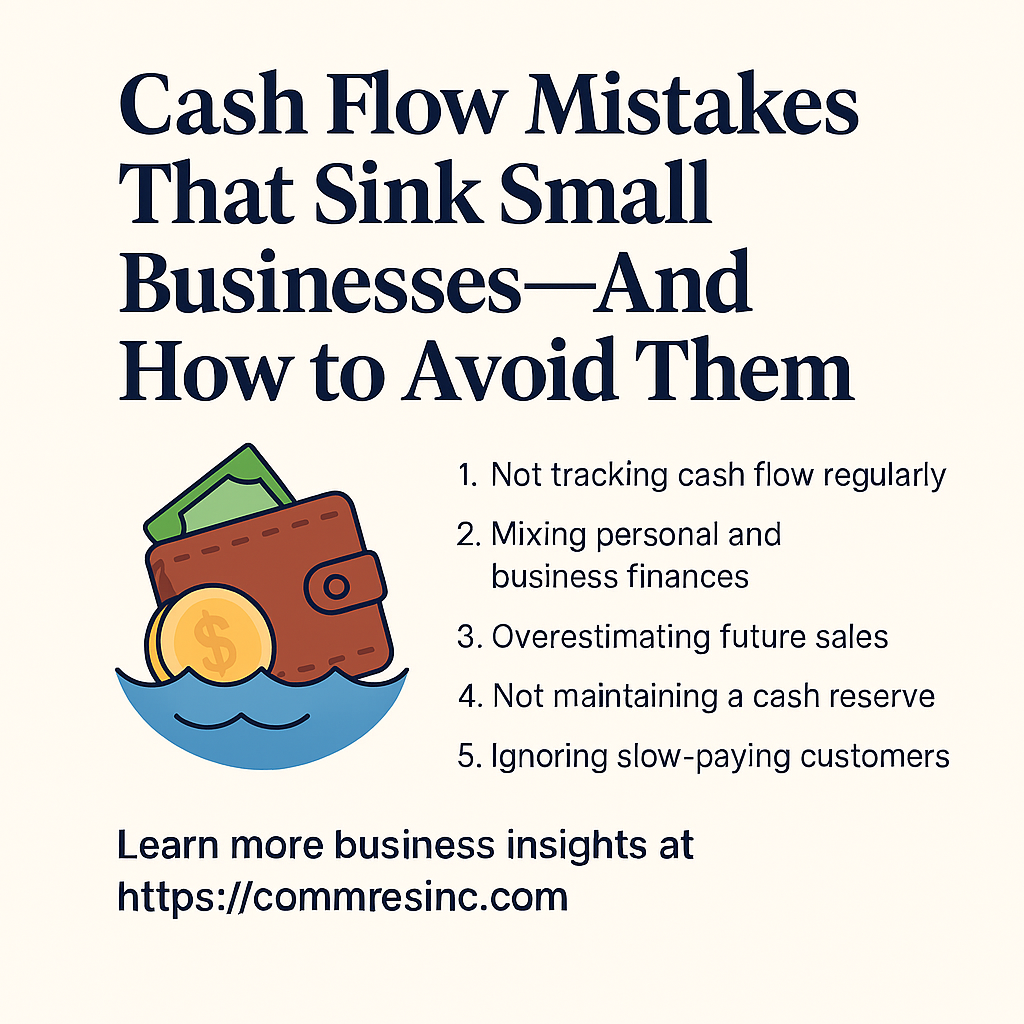
Cash Flow Mistakes That Sink Small Businesses—And How to Avoid Them

Healthy cash flow is the lifeblood of any small business. Even profitable companies can fail if money isn’t moving in and out in a stable, predictable way. Below are the most common cash flow mistakes small business owners make—and how to avoid them so your business stays strong and sustainable.


1. Confusing Profit With Cash Flow

Many business owners assume that because the company is making a profit, cash flow is automatically healthy. But profit is an accounting number—cash flow is real money in the bank.

Why it’s dangerous:
You may appear profitable on paper while struggling to pay bills, payroll, or suppliers.

How to avoid it:

  • Monitor your cash flow statement monthly.
  • Use accounting software that gives real‑time cash insights.
  • Build a 3–6 month cash reserve.

🔗 Need help understanding your cash position? Check out financial tools and resources at https://commresinc.com.


2. Slow or Unpredictable Invoicing

Late invoicing means late payments—and that can cripple your cash cycle.

Why it’s dangerous:
If you delay sending invoices by even a week, you may extend your payment cycle by 30+ days.

How to avoid it:

  • Invoice immediately when work is completed.
  • Automate recurring invoices.
  • Offer early‑payment incentives.

3. Letting Accounts Receivable Grow Out of Control

Outstanding invoices = money you’ve earned but can’t use.

How to avoid it:

  • Enforce clear payment terms (Net 15 or Net 30).
  • Follow up regularly—don’t wait 60+ days.
  • Charge late fees when appropriate.

4. Overspending on Inventory

Too much inventory ties up cash that could be used for growth or emergencies.

How to avoid it:

  • Use sales forecasting to order what you need.
  • Track turnover rates.
  • Negotiate with suppliers for smaller, more frequent shipments.

5. Not Planning for Seasonal Fluctuations

Almost every industry has seasonal highs and lows.

How to avoid it:

  • Review your financial history to identify patterns.
  • Adjust staffing and inventory to match slower months.
  • Save during peak periods to cover lean periods.

6. Relying Too Heavily on One Customer

If one customer makes up more than 30–40% of your revenue, your cash flow is at risk if they slow down or disappear.

How to avoid it:

  • Diversify your customer base.
  • Create multiple revenue streams.
  • Build long‑term contracts when possible.

7. Not Using Cash Flow Forecasting

Forecasting lets you predict shortages before they become emergencies.

How to avoid it:

  • Create a 12‑month cash flow forecast and update it monthly.
  • Stress‑test different scenarios (slow sales, sudden expenses).
  • Review budgets and adjust spending proactively.

🔗 If you’d like expert help designing a smart cash flow system or want business optimization services, visit https://commresinc.com.


8. Operating Without a Line of Credit

A line of credit is a safety net—not a sign of financial weakness.

How to avoid it:

  • Set up a line of credit before you need it.
  • Use it strategically to bridge short‑term gaps.
  • Avoid relying on it for ongoing expenses.

Final Thoughts

Cash flow problems don’t happen overnight—they build slowly through small, avoidable mistakes. By monitoring your finances, invoicing promptly, forecasting ahead, and keeping your expenses aligned with your revenue cycle, you can strengthen your business and prevent crises before they start.

If you’re ready to improve your business operations, explore the services and tools available at https://commresinc.com.