Small Business Financing in 2026: What Commercial Clients Need to Know Before Securing Capital

For many businesses, securing capital isn’t just about growth — it’s about survival, stability, and staying competitive in a marketplace transformed by technology and rising costs. In 2026, small business financing has become more flexible, more data‑driven, and more specialized, offering companies a wider variety of tools to fund their operations, equipment needs, and expansion plans. However, this new landscape also demands that business owners make smarter, more strategic funding choices.

This guide breaks down the most important financing trends and tools shaping the market today — and what they mean for Commercial Resources’ clients who rely on smart, accessible capital solutions.


1. Today’s Lending Environment Is Faster, Smarter, and Data‑Driven

Traditional lending models have shifted dramatically. Instead of relying mainly on credit scores and historical tax returns, many lenders now use real‑time financial data pulled directly from accounting and commerce platforms to assess risk. Systems such as QuickBooks, Stripe, Amazon, and Shopify now feed lenders live cash‑flow intelligence.

At the same time, interest rates remain higher than pre‑pandemic levels, and lenders — both traditional banks and fintech companies — expect businesses to provide clear financials and repayment plans before approving applications.

What this means for Commercial Resources clients:
Your real‑time financial health matters more than ever. Clean books, accurate statements, and steady revenue data help you secure better rates and faster approvals.

2. Smaller, Purpose‑Driven Loans Are Becoming the Norm

One of the most notable trends moving into 2026 is the shift toward smaller, targeted financing products. Instead of large, broad‑use loans, businesses now secure capital for highly specific purposes — such as equipment upgrades, inventory cycles, marketing pushes, or short‑term working capital needs.

Lenders favor these smaller, project‑based loans because they carry less risk and have clearer return pathways.

What this means for Commercial Resources clients:
A well‑defined purpose for your funding request — such as equipment replacement or facility upgrades — dramatically increases approval odds.

3. Revenue‑Based Financing Is Expanding, Especially for Online Sellers

Revenue‑based financing (RBF) continues to gain traction, especially among eCommerce and digital‑first businesses. With RBF, repayment is tied to a percentage of future revenue — meaning payments flex as sales fluctuate.

Platforms like Onramp Funds provide fast access to capital (sometimes within 24 hours) by integrating directly with online sales platforms.

What this means for Commercial Resources clients:
If your business has cyclical or seasonal revenue, RBF may offer the flexibility you need without the pressure of fixed monthly payments.


4. Traditional Loans Still Matter — but Preparation Is Essential

Despite new alternatives, conventional business loans remain a cornerstone of commercial financing. They often offer lower long‑term costs, predictable amortization, and access to higher dollar amounts. However, lenders now expect:

  • clean, accurate financial statements
  • clear cash‑flow projections
  • a defined use of funds
  • proof of repayment capacity

Loan approvals are increasingly based on real‑time operational health rather than long‑term credit history alone.

What this means for Commercial Resources clients:
Well‑prepared documentation and clearly defined needs help secure better, more stable financing terms.


5. Grants and Tax Incentives Offer Often‑Overlooked Opportunities

Every year, small businesses miss out on valuable grants and tax credits simply because they aren’t aware they exist.

For example:

Notable Grants (Public + Private)

Grants from American Express, QuickBooks, DoorDash, and other national programs support a range of industries

Powerful Federal Tax Credits

  • Section 179 Deduction: write off up to $1.22 million on equipment and software purchases in 2026
  • R&D Tax Credit: offsets 6–14% of qualified R&D expenditures, even for non‑tech businesses [esplawyers.com]

What this means for Commercial Resources clients:
If you’re acquiring equipment or improving products/processes, leveraging tax incentives can dramatically reduce out‑of‑pocket spending.


6. Relief Programs Still Provide Critical Support

Many businesses still qualify for federal, state, and private relief programs — including grants, credits, subsidized loans, and sector‑specific assistance. Many owners incorrectly assume they won’t qualify, leaving thousands of dollars unused.

What this means for Commercial Resources clients:
It’s worth reviewing relief programs annually — many are industry‑specific and underutilized.


7. Strategic Financing Helps You Grow Without Draining Cash

A common mistake business owners make is using their operating cash to fund expansions — weakening payroll stability, inventory budgets, and emergency reserves.

Instead, experienced businesses separate:

  • operating capital (day‑to‑day expenses)
  • expansion financing (growth investments)

Strategic financing enables growth while protecting liquidity.

What this means for Commercial Resources clients:
Financing should fuel expansion — not jeopardize your operational cash flow.


8. Preparing for Financing in 2026

To get the best rates and widest range of options, businesses should be prepared with:

  • updated financial statements
  • clean, reliable bookkeeping
  • consistent revenue records
  • a clear explanation of how funds will be used
  • organized digital financial data for lenders who integrate with accounting platforms

With fintech lenders increasingly using real‑time data to evaluate your business, clean financial systems have become essential.


Final Thoughts

Small business financing in 2026 is more dynamic, more flexible, and more technologically advanced than ever before. Whether you need capital for equipment, expansion, staffing, or cash‑flow stabilization, today’s market offers more options than at any point in history.

But choosing the right financing tool requires clarity, preparation, and strategy.

Commercial Resources is here to help your business navigate this evolving landscape, secure the capital you need, and grow without compromising your operational stability.

How Tax Season Can Affect Your Ability to Get a Small Business Loan (and What Smart Borrowers Should Do About It)

Tax season isn’t just about preparing returns — it can directly impact your ability to secure financing, buy a business, or purchase commercial property. Whether you’re seeking an SBA loan, bank financing, or alternative funding, the accuracy and strength of your tax documentation play a major role in how lenders evaluate your business.

Below is a practical, lender-focused guide on how tax season affects financing approvals — and what business owners and commercial buyers can do to improve their chances.


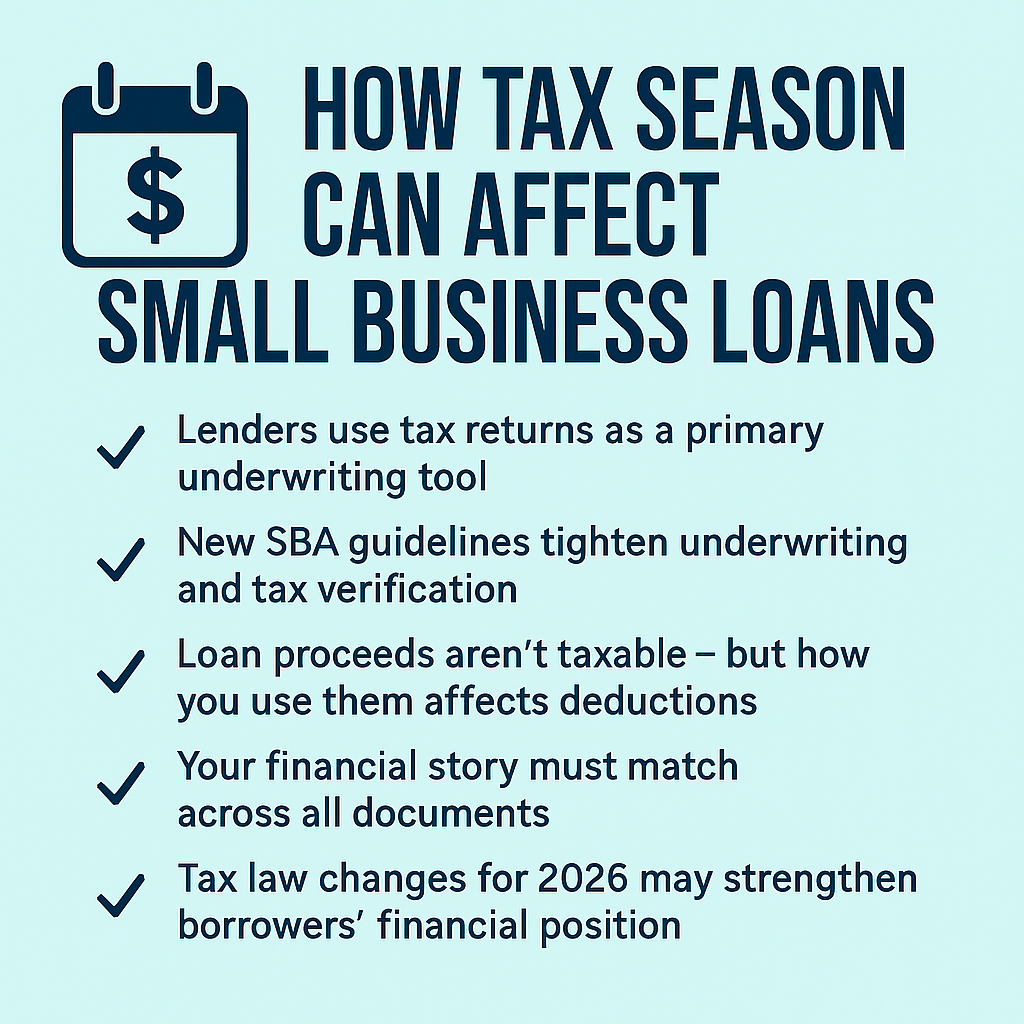
1. Lenders Use Your Tax Returns as a Primary Underwriting Tool

When underwriting a loan, lenders rely heavily on business and personal tax returns to confirm financial stability, verify income, and reconcile cash flow. Business tax returns (usually the last 2–3 years) are used to validate earnings, examine deductions, and confirm tax compliance. Underwriters compare these tax returns with financial statements and bank activity, checking for consistency, unusual items, and signs of risk. Personal tax returns are also reviewed for owners of small businesses, particularly sole proprietors and LLCs, since personal income is closely tied to business operations. [finhelp.io]

If required returns are missing or incomplete, the business is not eligible for SBA financing until those documents are filed and verified. Lenders must obtain IRS tax transcripts and match them against the financial information submitted during underwriting, making accurate filings essential. [starfieldsmith.com]


2. New SBA Guidelines Tighten Underwriting and Tax Verification

Recent updates to SBA lending rules have restored more rigorous underwriting standards for both 7(a) and 504 loans. As of June 1, 2025, lenders must follow updated Standard Operating Procedures that include tax transcript verification, stricter eligibility rules, and more responsibility placed on lenders to confirm the accuracy and reliability of financial information. These updates reverse relaxed rules from recent years and reinforce compliance requirements during tax season. [congress.gov]

In addition, lenders must reinstate tax transcript verification for all SBA 7(a) and 504 loans before disbursing funds — meaning any errors, omissions, or delays in filing tax returns can stall or derail your loan approval. These changes emphasize the importance of keeping tax filings current, orderly, and accessible. [cdcloans.com]


3. Loan Proceeds Aren’t Taxable — But How You Use Them Affects Deductions

Many business owners are surprised to learn that loan proceeds are not considered taxable income, because they are liabilities that must be repaid. However, interest payments, origination fees, and other costs associated with obtaining the loan can often be deducted as business expenses. Using loan funds for operating expenses typically results in deductible expenses in the same year, while capital asset purchases (such as equipment or commercial property) may be depreciated over time. [biggerbottomline.com]

This makes proper tax planning essential for owners preparing to acquire property or expand operations through financing.


4. Your Financial Story Must Match Across All Documents

During underwriting, lenders compare returns, financial statements, and bank activity to confirm the business’s financial picture. They look for:

  • Consistent revenue and expense reporting
  • Clear cash flow sufficient to support debt payments
  • No unpaid taxes or compliance issues
  • Stability in personal income for owners
    [finhelp.io]

Discrepancies in reporting — even unintentional ones — can trigger delays, additional document requests, or loan denials during tax season when filings are freshly updated.


5. Tax Law Changes for 2026 May Strengthen Borrowers’ Financial Position

Sweeping tax reforms under the One Big Beautiful Bill Act have restored or expanded multiple business tax benefits that can improve profitability and cash flow — two metrics lenders monitor closely. For example, the permanent return of 100% bonus depreciation allows businesses to expense qualifying property immediately, and the permanent 20% Qualified Business Income (QBI) deduction helps many pass‑through entities reduce taxable income. These provisions can strengthen financial ratios that lenders evaluate for loan approval. [integrabiz…utions.com]

Better tax outcomes can translate into stronger loan applications, especially for buyers preparing to acquire property or expand operations.


6. What Business Owners Should Do Before Applying for Funding

If you plan to purchase a commercial property, buy a business, or obtain growth capital this year, consider taking these steps:

File all business and personal tax returns early

Lenders cannot proceed without complete filings and IRS verification.

Clean up financial statements

Ensure your profit & loss, balance sheet, and cash flow statements align with tax returns.

Review deductions and write-offs

Excessive deductions may reduce taxable income but can make your business appear less profitable to lenders.

Work with an accountant who understands lending

The SBA specifically recommends professional accounting support to avoid errors and reduce audit risk. [creditsuite.com]

Prepare to explain variances

If income fluctuated year to year, be ready to provide documentation or narrative explanations.


Final Thoughts: Tax Season Is Your Opportunity to Strengthen Your Loan Readiness

Tax season isn’t just a compliance obligation — it’s one of the most important factors affecting small business financing. Clean, accurate, and consistent tax documents can streamline the loan process, increase approval odds, and position you competitively when pursuing commercial property or acquiring a business.

If you need help evaluating your readiness for financing or assembling loan‑ready financials, Commercial Resource, Inc. can guide you through the process and connect you with the right lenders and funding options.

A Practical Guide to Hotel Financing

Hotel financing is a specialized area of commercial real estate lending that reflects the unique operational and market risks of the hospitality industry. Unlike office buildings or multifamily properties, hotels rely heavily on daily occupancy, brand strength, location, and management performance. As a result, lenders evaluate hotel projects differently—and borrowers must be prepared to meet higher underwriting standards.

This article explores the fundamentals of hotel financing, common loan structures, key underwriting factors, and strategies for improving financing outcomes.


Understanding Hotel Financing

Hotel financing refers to the capital used to acquire, develop, renovate, or refinance hospitality properties such as hotels, motels, and resorts. Financing can be secured through traditional banks, commercial mortgage-backed securities (CMBS), private lenders, government‑backed programs, and equity investors.

Because hotel revenue fluctuates daily and is highly sensitive to economic cycles, lenders typically view hotels as higher‑risk assets. This risk profile influences loan terms, interest rates, leverage limits, and required borrower experience.


Common Types of Hotel Financing

1. Acquisition Financing

Used to purchase an existing hotel, acquisition loans typically require detailed historical operating data, including occupancy rates, average daily rate (ADR), and revenue per available room (RevPAR). Lenders will assess property condition, brand affiliation, and local market performance.

2. Construction and Development Loans

Financing a ground‑up hotel development is more complex and often involves multiple capital sources. Construction loans are usually short‑term, interest‑only, and require significant equity contributions—often 25% to 40% of total project costs. Lenders favor experienced developers and strong brand backing.

3. Renovation and PIP Financing

Many branded hotels require Property Improvement Plan (PIP) upgrades to maintain franchise agreements. Renovation loans may be structured as standalone financing or combined with refinancing, depending on scope and borrower strength.

4. Refinancing

Hotel owners may refinance to lower interest rates, pull out equity, or restructure debt. Refinancing often depends on stabilized cash flow, consistent operating history, and improved market conditions.


Key Underwriting Factors

Lenders evaluate hotel financing requests using a combination of financial, operational, and market‑based criteria:

Cash Flow and Performance Metrics

Metrics such as Net Operating Income (NOI), RevPAR, occupancy, and ADR are critical. Lenders typically stress cash flows to account for volatility.

Loan‑to‑Value (LTV) Ratios

Hotel loans generally carry lower LTVs than other property types, often ranging from 55% to 70%, depending on deal strength.

Debt Service Coverage Ratio (DSCR)

A DSCR of 1.30x or higher is commonly required, though this can vary by lender and market.

Sponsor Experience

Borrowers with proven hotel ownership or management experience are significantly more attractive to lenders.

Brand and Management

Affiliation with a recognized hotel brand and the use of an experienced management company can materially improve financing terms.


Financing Sources for Hotels

Traditional Banks

Banks offer competitive pricing but tend to be conservative, favoring stabilized assets in strong markets.

Private and Debt Funds

Private lenders provide greater flexibility, higher leverage, and faster execution—often at higher interest rates.

CMBS Lenders

CMBS loans can offer non‑recourse financing with longer terms but involve complex structures and less flexibility.

Government‑Backed Programs

Programs such as SBA 504 or 7(a) loans may be available for owner‑operated hotels, particularly for smaller properties.

Equity Partners

When debt alone is insufficient, developers may bring in equity partners or joint‑venture investors to complete capitalization.


Improving Financing Outcomes

Hotel owners and developers can strengthen financing prospects by:

  • Preparing detailed financial projections and feasibility studies
  • Demonstrating strong sponsorship and operational expertise
  • Securing brand approval early in the process
  • Investing adequate equity upfront
  • Working with brokers or advisors who specialize in hospitality finance

Early planning and realistic assumptions are essential, particularly in volatile or developing markets.


Conclusion

Hotel financing requires a careful balance between risk management and growth opportunity. Because hospitality assets behave differently than other commercial properties, borrowers must understand lender expectations and structure their projects accordingly. With strong fundamentals, experienced sponsorship, and thoughtful capitalization, hotel financing can support both short‑term development goals and long‑term investment success.

Smart Strategies for Small Business Financing

Access to financing is one of the biggest challenges small businesses face. Whether you’re launching a startup or expanding operations, understanding your funding options is critical for success.

Why Financing Matters
Proper financing ensures you have the resources to cover operating costs, invest in growth, and weather unexpected challenges.

Top Financing Options for Small Businesses

  1. Traditional Bank Loans
    • Ideal for businesses with strong credit and collateral.
  2. SBA Loans
    • Government-backed loans with favorable terms for small businesses.
  3. Business Lines of Credit
    • Flexible funding for short-term needs.
  4. Equipment Financing
    • Perfect for businesses needing machinery or technology upgrades.
  5. Alternative Lenders
    • Faster approvals, though often at higher interest rates.

Tips for Success

  • Maintain a strong credit profile.
  • Prepare a detailed business plan.
  • Compare multiple lenders for the best terms.

Conclusion
Financing doesn’t have to be overwhelming. By exploring the right options and planning ahead, you can secure the capital your business needs to thrive.

📌 Learn more and get expert guidance at: commresinc.com

Understanding SBA Loans — A Smart Path to Small Business Growth

Small Business Administration (SBA) loans are one of the most effective and accessible financing tools available to entrepreneurs today. Whether you’re a startup looking to fund early operations or an established business wanting to expand, SBA loans provide the flexible, affordable support many traditional loans can’t match.

What Makes SBA Loans Unique?

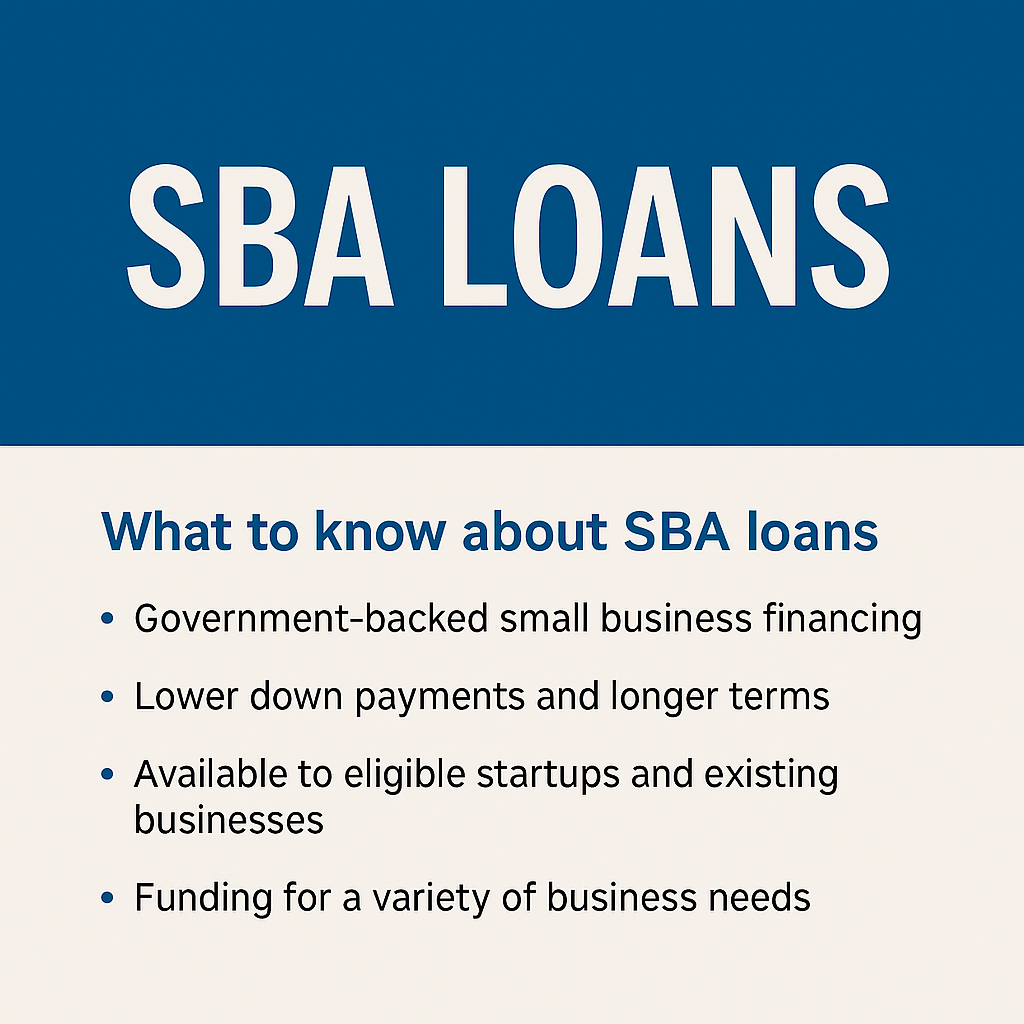
Unlike conventional loans, SBA loans are partially guaranteed by the federal government. This reduces risk for lenders and makes it easier for small business owners to qualify. In many cases, SBA loans come with lower down payments, longer repayment terms, and competitive interest rates, making them a go‑to solution for businesses across industries.

💼 Types of SBA Loans

1. SBA 7(a) Loan

The most popular and versatile SBA loan.
Perfect for:

  • Working capital
  • Equipment purchases
  • Business acquisition
  • Expansion or renovation

2. SBA 504 Loan

Designed for large, long‑term investments such as:

  • Commercial real estate
  • Heavy machinery
  • Major infrastructure upgrades

3. SBA Microloans

Ideal for startups or very small businesses that need $50,000 or less.
Great for:

  • Initial inventory
  • Supplies
  • Small equipment

📋 Common Eligibility Requirements

To qualify for an SBA loan, lenders typically look for:

  • A solid business plan
  • Good personal and business credit
  • Proof of ability to repay
  • U.S.‑based business operating for profit

Because SBA loans are government‑backed, documentation requirements are more detailed — but the payoff is worth it for the lower risk and better terms.

🚀 How SBA Loans Support Business Growth

SBA loans help business owners:

  • Improve cash flow
  • Expand into new products or markets
  • Hire additional staff
  • Invest in long‑term assets
  • Build a stronger operational foundation

For many businesses, an SBA loan becomes the catalyst that drives long‑term success and stability.

📝 Final Thoughts

Securing financing can feel overwhelming, but SBA loans are intentionally designed to make capital more accessible for small businesses. With flexible repayment options and broad eligibility, they remain one of the most powerful tools for entrepreneurs ready to scale.

If you’re considering an SBA loan, now is a great time to evaluate your needs and prepare a strong application package. With the right preparation, SBA funding can provide the momentum your business needs to grow confidently and sustainably.