SBA 504 Refinance: Unlock Better Rates & Strengthen Your Business

If your business is carrying high-interest debt tied to real estate or equipment, an SBA 504 refinance could be one of the smartest financial moves you make.

With today’s evolving interest rate environment, now is the perfect time to check your rate and explore how refinancing can improve your cash flow, stability, and long-term growth.

What Is an SBA 504 Refinance?

The SBA 504 Loan Program was designed to help small businesses secure long-term, fixed-rate financing for major assets like commercial real estate and equipment.

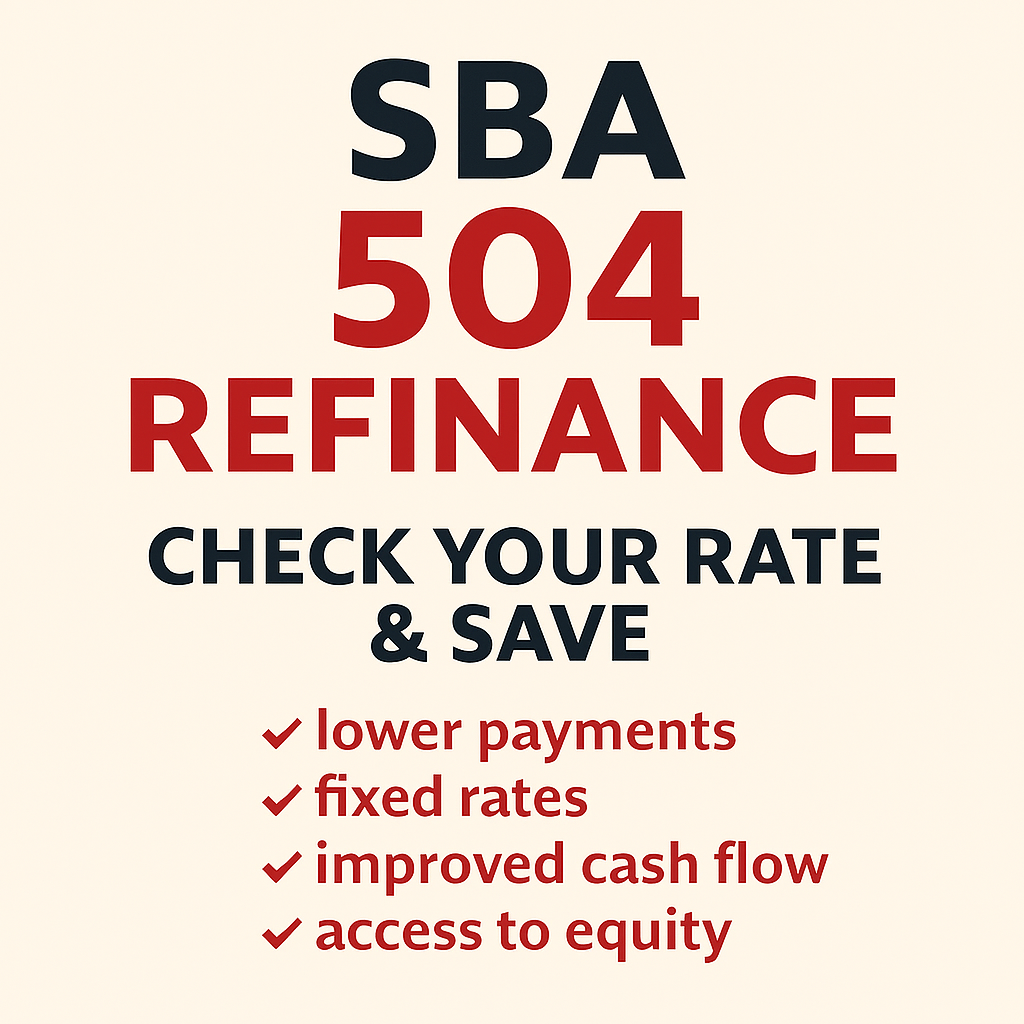
Through refinancing, the SBA 504 program allows you to:

  • Replace existing commercial debt
  • Lock in lower, fixed interest rates
  • Access equity for business needs

This is a powerful option for businesses currently dealing with variable rates or higher-cost traditional loans.

Key Benefits of an SBA 504 Refinance

✅ 1. Lower Monthly Payments

Refinancing into a longer-term, fixed-rate structure often reduces your monthly payment, freeing up capital for operations, hiring, or expansion.

✅ 2. Fixed Interest Rates = Predictability

Unlike fluctuating rates, SBA 504 loans offer stable, long-term fixed rates, helping you plan your finances with confidence.

✅ 3. Improved Cash Flow

Lower payments plus stable rates = healthier cash flow, which is critical for:

  • Covering operating expenses
  • Investing in growth opportunities
  • Weathering economic uncertainty

✅ 4. Access to Equity

If your property has appreciated, refinancing may allow you to pull out usable equity to reinvest into your business.

✅ 5. Consolidate Business Debt

You may be able to combine multiple loans into one, simplifying your finances and reducing overall interest costs.

✅ 6. Strengthen Your Balance Sheet

Refinancing into better terms can improve your financial profile—making your business more attractive to lenders and investors.

Who Qualifies?

An SBA 504 refinance is ideal for businesses that:

  • Own and occupy commercial real estate
  • Have existing debt tied to that property
  • Are looking to lower rates or improve cash flow
  • Have been operating for at least 2 years (in most cases)

Even if you’re unsure, it’s worth taking a closer look—many businesses qualify sooner than they expect.

Why Now Is the Time to Check Your Rate

Interest rates shift constantly, and many businesses are still carrying loans secured during less favorable conditions.

That means you could be:

  • Paying more than necessary
  • Missing out on long-term savings
  • Limiting your growth potential

A simple rate check could reveal significant savings opportunities.

Real Impact: What Refinancing Can Do

Businesses that refinance using SBA 504 loans often see:

  • Lower operating stress
  • More available working capital
  • Better long-term planning ability
  • Increased profitability over time

It’s not just about saving money—it’s about positioning your business for success.

Take the Next Step: Check Your Rate

Refinancing doesn’t have to be complicated. The first step is simple:

👉 Check your current rate and explore your options

By comparing your existing loan with SBA 504 refinancing, you can quickly determine if there’s an opportunity to:

  • Save money
  • Improve cash flow
  • Strengthen your business

Final Thoughts

An SBA 504 refinance is more than a financial adjustment—it’s a strategic move that can give your business the stability and flexibility it needs to grow.

If you haven’t reviewed your loan recently, now is the time.

✅ Lower your rate
✅ Improve your cash flow
✅ Invest back into your business

🚀 Ready to see what you qualify for?

Check your rate today and take control of your financial future.

Cash Flow 101: What Every Small Business Owner Must Understand

Managing cash flow is one of the most essential skills for any small business owner. Even profitable businesses can struggle — or fail — if cash isn’t flowing in at the right time. Understanding how money moves in and out of your business gives you the power to plan, grow, and stay resilient during slow seasons or unexpected expenses.

What Is Cash Flow?

Cash flow is the movement of money into (inflows) and out of (outflows) your business.

  • Positive cash flow means more money is coming in than going out — ideal for stability and growth.
  • Negative cash flow means you have more expenses than revenue during a given period — a warning sign that requires quick action.

Even if revenue looks strong on paper, delayed payments, rising expenses, or seasonal demand can leave your bank account depleted.

Why Cash Flow Matters More Than Profit

You can be profitable without being cash‑flow positive.

For example:
You might land a big contract, but if the customer doesn’t pay for 60 days and you need to cover payroll tomorrow, you have a cash flow problem — not a profitability problem.

Cash flow directly affects your ability to:

  • Pay employees and vendors
  • Cover rent, utilities, and supplies
  • Invest in equipment or marketing
  • Take advantage of growth opportunities
  • Weather slow months without panic

Profit is long‑term.
Cash flow is day‑to‑day survival.

The Three Types of Cash Flow

Understanding where your cash comes from helps identify strengths and risks.

1. Operating Cash Flow

Everyday business activities: sales, services, vendor payments, wages, taxes.

2. Investing Cash Flow

Buying or selling long‑term assets: equipment, vehicles, property.

3. Financing Cash Flow

Loans, credit lines, owner investments, or dividend payouts.

Operating cash flow is the heartbeat of your business. If it’s consistently negative, something fundamental must change.

How to Improve Your Cash Flow

Here are practical steps you can implement immediately:

1. Speed Up Your Inflows

  • Invoice promptly and clearly
  • Offer early‑payment incentives
  • Accept multiple payment methods
  • Require deposits or partial payments for large projects

2. Slow Down Your Outflows

  • Negotiate better terms with vendors
  • Schedule payments closer to due dates
  • Reduce unnecessary recurring expenses

3. Monitor Your Cash Flow Weekly

Weekly reviews prevent surprises. Look for patterns:

  • Which months are slow?
  • Which expenses keep creeping up?
  • Are customers paying later than before?

4. Build a Cash Cushion

Aim for at least 1–3 months of operating expenses in reserve.
This buffer protects you from late payments or seasonal dips.

5. Use a Cash Flow Forecast

Project your cash position 30, 60, and 90 days ahead.
This helps you anticipate shortages before they hit.

Common Cash Flow Mistakes (and How to Avoid Them)

Counting sales before cash arrives

✔ Track real deposits — not promised payments.

Not budgeting for taxes

✔ Create a tax savings account and set aside a percentage of every sale.

Over‑ordering inventory

✔ Keep inventory levels aligned with real demand.

Ignoring rising expenses

✔ Audit subscriptions, service fees, and supply costs quarterly.

Not separating personal and business finances

✔ Use separate accounts so cash flow is easy to track and analyze.

Tools That Help You Track Cash Flow

  • Accounting software with dashboards (QuickBooks, Xero, Wave)
  • Cash flow forecasting apps
  • Business banking accounts with built‑in analytics
  • Simple spreadsheets for weekly check‑ins

The tool matters less than consistency.

Final Thoughts

Mastering cash flow isn’t just good financial practice — it’s a competitive advantage. Businesses that understand and monitor cash flow run more smoothly, make better decisions, and stay strong even during unpredictable times.

Whether you’re brand new or growing fast, cash flow is the foundation. When you manage it well, everything else becomes easier.

Cash Flow Mistakes That Sink Small Businesses—And How to Avoid Them

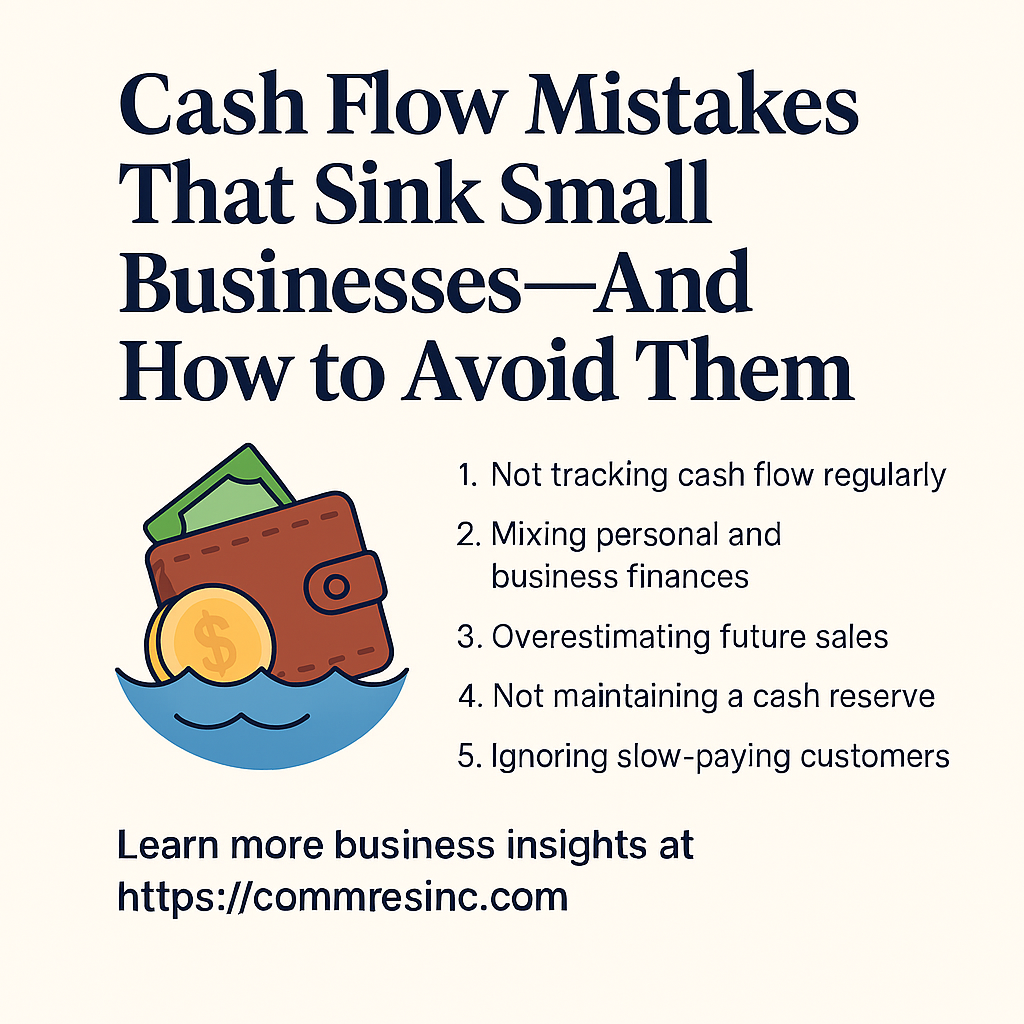
Healthy cash flow is the lifeblood of any small business. Even profitable companies can fail if money isn’t moving in and out in a stable, predictable way. Below are the most common cash flow mistakes small business owners make—and how to avoid them so your business stays strong and sustainable.


1. Confusing Profit With Cash Flow

Many business owners assume that because the company is making a profit, cash flow is automatically healthy. But profit is an accounting number—cash flow is real money in the bank.

Why it’s dangerous:
You may appear profitable on paper while struggling to pay bills, payroll, or suppliers.

How to avoid it:

  • Monitor your cash flow statement monthly.
  • Use accounting software that gives real‑time cash insights.
  • Build a 3–6 month cash reserve.

🔗 Need help understanding your cash position? Check out financial tools and resources at https://commresinc.com.


2. Slow or Unpredictable Invoicing

Late invoicing means late payments—and that can cripple your cash cycle.

Why it’s dangerous:
If you delay sending invoices by even a week, you may extend your payment cycle by 30+ days.

How to avoid it:

  • Invoice immediately when work is completed.
  • Automate recurring invoices.
  • Offer early‑payment incentives.

3. Letting Accounts Receivable Grow Out of Control

Outstanding invoices = money you’ve earned but can’t use.

How to avoid it:

  • Enforce clear payment terms (Net 15 or Net 30).
  • Follow up regularly—don’t wait 60+ days.
  • Charge late fees when appropriate.

4. Overspending on Inventory

Too much inventory ties up cash that could be used for growth or emergencies.

How to avoid it:

  • Use sales forecasting to order what you need.
  • Track turnover rates.
  • Negotiate with suppliers for smaller, more frequent shipments.

5. Not Planning for Seasonal Fluctuations

Almost every industry has seasonal highs and lows.

How to avoid it:

  • Review your financial history to identify patterns.
  • Adjust staffing and inventory to match slower months.
  • Save during peak periods to cover lean periods.

6. Relying Too Heavily on One Customer

If one customer makes up more than 30–40% of your revenue, your cash flow is at risk if they slow down or disappear.

How to avoid it:

  • Diversify your customer base.
  • Create multiple revenue streams.
  • Build long‑term contracts when possible.

7. Not Using Cash Flow Forecasting

Forecasting lets you predict shortages before they become emergencies.

How to avoid it:

  • Create a 12‑month cash flow forecast and update it monthly.
  • Stress‑test different scenarios (slow sales, sudden expenses).
  • Review budgets and adjust spending proactively.

🔗 If you’d like expert help designing a smart cash flow system or want business optimization services, visit https://commresinc.com.


8. Operating Without a Line of Credit

A line of credit is a safety net—not a sign of financial weakness.

How to avoid it:

  • Set up a line of credit before you need it.
  • Use it strategically to bridge short‑term gaps.
  • Avoid relying on it for ongoing expenses.

Final Thoughts

Cash flow problems don’t happen overnight—they build slowly through small, avoidable mistakes. By monitoring your finances, invoicing promptly, forecasting ahead, and keeping your expenses aligned with your revenue cycle, you can strengthen your business and prevent crises before they start.

If you’re ready to improve your business operations, explore the services and tools available at https://commresinc.com.